Tag: gamification

  • Core Drives of Gamification: The Relevance of Social Influence & Relatedness

    Core Drives of Gamification: The Relevance of Social Influence & Relatedness

    by Bryan Woo, Simulation Designer

    Social Influence & Relatedness refers to a core drive in Yu-Kai Chou’s Octalysis Framework. Simulation Designer Bryan Woo talks about his experience with this core drive and how it guided him to undergo behavioural change in a natural way.  

    The year was 2012 and I was walking towards campus for my first day at college. It was orientation day and campus was packed with people, mostly parents dropping their children off, and other students making their way from one place to another.

    I would be lying to you if I said that I wasn’t nervous. It was a lot to take in, especially when you’re trying to keep up with a pace that you aren’t used to. Growing up in a small town in Perak, Malaysia was rather slow paced as compared to the hustle and bustle of a capital city like Kuala Lumpur.

      Photo by Zukiman Mohamad from Pexels
    Photo by Zukiman Mohamad from Pexels

    Eventually, my day went on with icebreakers and speeches. I made a few new acquaintances with some of my peers during those activities, but nothing beyond your typical “Hi, nice to meet you, bye” interactions, since most were already part of their own social circles.

    So ended my first day of college.

    As I walked back to my dorm, I was beginning to worry that I would struggle to make new friends and cope with living away from home. Well, at least until my roommate moved in a few days later. Which to my surprise, was my old high school mate from back home!

    Long story short, the next few days got a lot easier after that, especially when socializing with others. I would like to think that having a familiar face around and seeing him enjoy his time here was the catalyst I needed to get out of my shell, and explore my new surroundings.

      Bryan breaking out of his shell
    Bryan breaking out of his shell

    Looking back, my experience back in college demonstrated Social Influence and Relatedness –  one of the core drives within Yu-Kai Chou’s Octalysis Framework in Gamification. This core drive incorporates social elements that drive people to do activities, when inspired by what other people think, do, or say.

    Social Influence refers to activities such as competition, mentorship, collaboration or group quests, companionship, and social treasures. Relatedness, on the other hand, takes about nostalgia and emotional associations, much like how storylines are crafted to appeal to certain audiences.

      Shared experiences forge bonds with an institute or group
    Shared experiences forge bonds with an institute or group

    Tying it back to my time in college, I experienced Relatedness in the form of my old roommate moving in and having a familiar face around from back home. Seeing him interact with new people and experiences has driven me to do the same, hence my being driven by Social Influence.

    Humans are considered social beings, and in a majority of our everyday activities we involve at least one or more other people. Activities like team sports, business meetings, working in an office space, church services, or other religious gatherings, etc..

      Photo by rawpixel.com from Pexels
    Photo by rawpixel.com from Pexels

    It is true that we also engage in these activities for other reasons, but there’s no denying that social influence is an equally important drive for each of them.

    Hence why gamification initiatives can benefit from tapping into this core drive. A well-designed program can foster genuine motivation and performance in regards to working in collaborative and competitive environments, thus allowing users to embrace new challenges and experiences together with others.  

  • How To Take The Role of Games In Business Seriously

    How To Take The Role of Games In Business Seriously

    Games have always been seen as an activity for entertainment and leisure, but not for work. Here we explore the place of games in the business world.

    By Andrew Lau

    Everyone has played games. It’s something we experience as part of growing up. Games help us to learn, to avoid repeating mistakes, to choose the right friends, to win graciously, and to lose well. These very things that happen during childhood are what we can also apply to our working lives.

     Gamifying business goals makes achieving them so much more desirable
    Gamifying business goals makes achieving them so much more desirable

    Lately, gamification has come into business in a big way. More and more companies are making time to play, whether to increase employee engagement through team-building activities, or to facilitate learning in a business environment.

    As someone who helps organizations develop their employees’ potential, I often find myself telling bosses that “people learn by doing”. When you need to coordinate with others to learn new concepts, change mindsets, or produce results, then reading slides and memorizing manuals are not effective.

    This is why I’ve spent most of my career building business simulations that help colleagues experience and resolve real-life challenges in a safe environment.

    Business simulations are powerful. They can be built to isolate and target specific issues. Most importantly, you can make mistakes and learn without impacting the real business world.

    Engagement Vs Efficiency: Why does Gamification work?

    For most people they often see the outward representation of games such as cards, tokens, badges, avatars, and leaderboards. However, the real secret lies behind the design of the gamification system.

     Behavorial design - Photo by Startup Stock Photos from Pexels
    Behavorial design – Photo by Startup Stock Photos from Pexels

    There are typically 2 types of system design in the world:

    i. Function-centered design creates systems with the end goal of efficiency. However, even though this system is efficient, it does not mean people are motivated or engaged to use it. Most systems in a business are designed this way.

    ii. Human-centered design on the other hand. focuses on user engagement and motivation instead. It makes people want to use a system and derive personal meaning from their interaction. The question that should be asked during design is “What do we want to make the user feel?” (Engagement) as opposed to “How can we make things faster?” (Efficiency)

    You’re Happier When You Play

    E-Learning is a classic case of function-centered design. Internal e-learning platforms are an efficient way to distribute content among employees. However, it’s usually not designed to actually motivate or engage your people to WANT to learn.

    Here’s how most people approach e-Learning.

    First we go for the quiz, and if we pass (hurray!), we are deemed to have learned the subject. If we fail, then we go through the drudgery of re-watching the videos, only most times, we don’t.

     How engaging is e-learning really?
    How engaging is e-learning really?

    We turn on the video, make a cup of coffee and chat with our colleagues or attend to our emails. We wait for the time when we can take the quiz again. If we fail, repeat coffee and emails till we get it correct.

    This is what learning through a function-centered designed system could look like.

    Learning through a human-centered design system is hugely different. The most obvious difference is that there is usually a big dose of gamification. Imagine if learning in organizations was geared through completing business missions and quests. The only way to complete missions would then be by applying theories and tools.

    Users also rapidly ideate and prototype their ideas in a safe environment. They use iteration to keep getting better at a competency. By the end of a learning session, their repeated actions would have formed the building blocks of new behaviours, ultimately bring results to organizations.

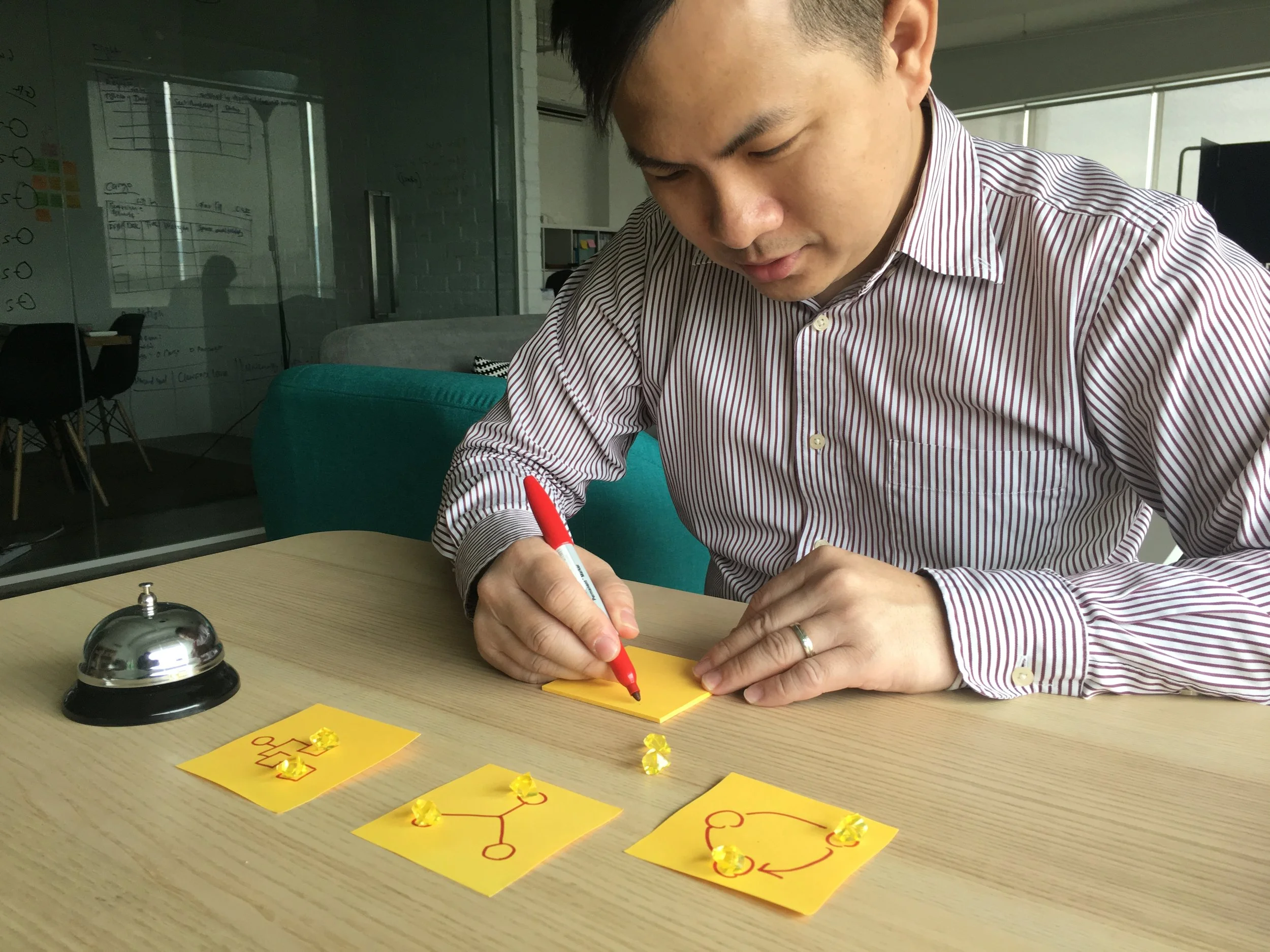
     Think Codex CEO Andrew Lau prototyping human-centered design concepts
    Think Codex CEO Andrew Lau prototyping human-centered design concepts

    Most importantly, users have a lot of fun while gaining insights.

    Gamification truly taps into the core of human-centered design. It’s about designing a system that gets your customers, employees, and even yourself, to be both extrinsically and intrinsically motivated toward desired actions.

    End Game

    So where does this leave us?

    Everybody loves games and are drawn to it because it connects us to who we are as humans.

    We are driven by:

    1. A positive sense of meaning, empowerment, social influence, accomplishment and ownership.
    2. A negative sense of unpredictability, scarcity and avoidance.

    All these drive human engagement and motivation.

    So, to drive results, the choice is simple. All you need to do is press Play.


    Andrew Lau is the CEO of Think Codex, a Learning Gamification Organization that believes the best way to get results is through human-centered systems. You can write him at andrew.lau@thinkcodex.com
     

  • Training & Development: Keeping your Millennials Engaged At Work

    Training & Development: Keeping your Millennials Engaged At Work

    By Bryan Woo, Simulation Designer

    As many organizations start to diversify themselves with more and more millennials, who will soon grow to dominate the workplace, it brings about an interesting challenge: how do you develop and keep your best millennials engaged at work?

       2016: Deloitte found that Millennials hold 20% of leadership roles
    2016: Deloitte found that Millennials hold 20% of leadership roles

    Research by Gallup has revealed that only 39% of millennials strongly agree that they have learnt something new within the last 30 days, as well as only 29% of millennials being engaged at work.

    Millennials that feel they have learnt something new

    Millennials that feel they are engaged at work

    The results are rather alarming, considering the fact that most organizations within the top quartile of employee engagement have been linked to 17% more productivity, 10% better customer ratings, as well as 21% more profitability as compared to their bottom tier counterparts.

    Interestingly enough, a fun fact about the average millennial is that they spent a staggering 2,000 – 3,000 hours reading books, and 3x that amount playing games before turning 21. Based on those numbers, we can be certain that millennials are very familiar to gameplay & game mechanics. Which brings me to my next point: What if you can tap into a millennial’s familiarity with games and carry that over into his or her learning and development, while at the same time, keeping them engaged at work?
     

    Enter, gamification.

    Gamification, in its simplest definition, is the process of using the fun & engaging elements found in games and applying them to non-game, real world environments in order to influence behaviour. It has gained popularity in use especially in classroom and other learning based environments.

    What makes gamification a unique learning approach. is that it is considered a form of “Human-Focused Design”, defined by Yu-kai Chou, an expert in gamification, as a design process specifically revolving around the learner in mind. This process places emphasis especially on the learner’s feelings, motivations, as well as engagement.

      Recapture the joy of learning as a kid. - Photo by  Ben White  on  Unsplash
    Recapture the joy of learning as a kid. – Photo by Ben White  on Unsplash
  • 5 Misconceptions of Gamification In Learning

    By Kerry Wong, Lead Simulation Designer

    1. You must be an experienced player

    Many people think that if they don’t play games regularly, they may not easily pick up games used for learning. However, the point of gamification in learning is to integrate game elements in the learning process to motivate participation and engagement among the learners, regardless of experience. 

    As a Benjamin Franklin quote goes “Tell me and I forget. Teach me and I remember. Involve me and I learn”. Gamification in learning works best when learners are involved, it doesn’t matter if they are not doing well in the game. It’s the process that matters, meaning games aren’t only meant for the pros. 

    2. Games are not meant for learning

    Growing up, most of us have been told by our parents that games are bad for you, it hinders your learning and you’re better off hitting the books the old-fashioned way. This simply isn’t true.

    Depending on the learning outcome you want to achieve and proper game-design, gamification can be a very conducive way for people to simulate real life experiences that prepare them to deal with scenarios they might face later in life. This is done by offering them a chance to roleplay and test their possible responses in a safe environment.

    3. Games are for nerds

    Gaming is often seen as too complex, and only for the nerds. While we are definitely in the age of the geeks, gamification in learning is often made simple to encourage understanding and engagement.

    As an example, Think Codex has a strategic thinking training that uses a simple board game setup to help teach complex theories in bite sizes, making it easier for learners to understand and apply it in the game.

    4. Games are for young people
     

    Older generations tend to be a bit hesitant about gaming, as they didn’t grow up with as much video game exposure as the younger generation today. But saying it’s only for young people is a myth of course, some of the oldest games include chess, go, checkers, poker, etc. 

    We believe that gamification can be used to target any age group by focusing on different kinds of behaviours and motivators, that align with different types of intelligence, motor skills and preferences. For example, a survey conducted based on Marczewski’s Player and User Types Hexad found that people within the age of 40-50 tend to be philanthropist; Philanthropist prefers collaborating with people and tend to learn through reflective observation. You can find out your own player type here!

    5. Gamification is just hype

    Some people have written off the rise of gamification as just a “phase”, but we think that gamification is here to stay, as we at Think Codex have seen how gamification has fostered better understanding and synergy in the workplace.

    With such incredible results and great feedback from our clients, we are sure that gamification’s growth in Malaysia and around the world will continue.