Tag: learning and development

  • Are You Ignoring the Key to L&D Success? The Importance of Employee Feedback

    Written by: Aaron Leong

    Every Learning and Development (L&D) team’s dream is to have committed and competent employees, the vehicle that drives an organization’s growth and profit in an ever-growing business landscape. It falls to the L&D teams in organizations, small and large, to develop and retain talents with the appropriate skills and attitude, yet this challenge has only increased following the pandemic. With the changes in employee expectations, more so with Generation Z entering the workforce, it is far too easy for managers to take on a reactive mindset and prematurely conclude that employee attitude or work ethic has deteriorated.

    As part of the L&D community, we are responsible for aligning employee career goals with company goals, so we must take a proactive mindset in understanding what underlies this phenomenon, and one such approach is through employee feedback.

     Co-workers engaging in discussion
    Co-workers engaging in discussion

    This article will first propose 4 ways an organisation’s L&D could benefit from listening to and acting on employee feedback. Next, we explain how employee feedback is inherently tied to the most essential elements of human motivation, which then predicts employee performance and retention.

    WHAT ARE THE 4 WAYS?

    1. Employee feedback gives you a clear picture of the skills or support that is currently missing in the team and, consequently, what type of support or training the team needs. With the increasing complexity of the technology and problems to solve, the plethora of platforms or business tools make it challenging for L&D to accurately identify the most relevant and appropriate for their company within budget and time constraints. Prior to adopting any new tool or introducing any new training programme, L&D needs to have a clear and accurate understanding of the challenges or roadblocks currently faced by employees. As such, employee feedback would highlight said issues, allowing the L&D team to accurately identify the relevant skills required by the employees. For example, employees could be stagnant in their careers and might benefit from a more structured way of brainstorming or strategic planning, but if you manage to identify that the employees already have excellent ideas, it is possible that their struggle lies with communicating their ideas in a clear and convincing manner. Since the L&D’s role is to ensure that employees are equipped to achieve the results that are expected of their position, employee feedback could shed light on the optimal way to use the company’s resources to grow the team.

     1 to 1 feedback with your manager often helps
    1 to 1 feedback with your manager often helps

    2. Furthermore, use employee feedback to ensure that the organizational and departmental policies remain effective and efficient in the current times. As organizations grow in reputation and teams grow in confidence and expertise, the tendency to become more homogeneous and rigid increases. This means that people are more susceptible to groupthink and struggle with divergent thinking, an important aspect of creative problem-solving and critical thinking. Moreover, sometimes our standard procedures or best practices might no longer be effective or efficient. Employee feedback would then be an important data-gathering process in obtaining diverse, and even dissenting, opinions. Clarity on what still works and what requires improvement shields the team from groupthink and prepares the company for future challenges before they occur.

    3. Additionally, it will ensure that the policies and processes in the organization are employee-centric, that is, the company’s vision is aligned with employees’ day-to-day work. Employees are more engaged and productive when their work and how they are treated at work are consistent and aligned with the organization’s vision and mission. For example, it would be hard-pressed for employees to think innovate and problem-solve in a culture that rewards rigid adherence to potentially outdated best practices. Rules and systems were created by people with specific purposes. Employees, the very people whom the vision and mission are meant to guide, would give you the most accurate feedback on whether the systems in place are achieving the purpose they are supposed to.

    4. A subtle, and less direct, effect of active listening and acting on employee feedback is forming a culture of learning. As L&D, we act as models and examples to employees in terms of how to behave and act at work. By demonstrating that we are open to upward feedback and constructive criticism, we establish a safe environment for sharing ideas and experiences, an environment that emphasizes self-improvement and encourages humility, creating a space to have difficult conversations. A learning culture encourages employees to be transparent about their mistakes or struggles, which are important predictors of eliminating mistakes in the future. A learning culture promotes collaboration and learning from one’s peers and mentors, resulting in growth in productivity and innovation. Conversely, a culture that prioritizes performance undermines psychological safety, encouraging employees to be guarded and always on the lookout for their own performance and career. In conclusion, a culture that practices upward feedback values improving ourselves instead of proving ourselves.

    Human Motivation

    The aforementioned advantages of feedback in L&D touch on three important elements of human motivation. Based on the Self-Determination Theory, humans are highly motivated and demonstrate quality performance in an environment that encourages autonomy, foster relatedness, and grows their competence. By providing the most relevant support and training, we increase employees’ competency, allowing them to excel in their work career development. By designing employee-centric policies, we encourage employees to practice their autonomy as their feedback and engagement with the L&D could improve their work conditions and have an impact on the organization. Employees would then feel that they are part of the company as opposed to feeling like a replaceable cog in a machine, encouraging them to take ownership of their careers and increase their commitment. 
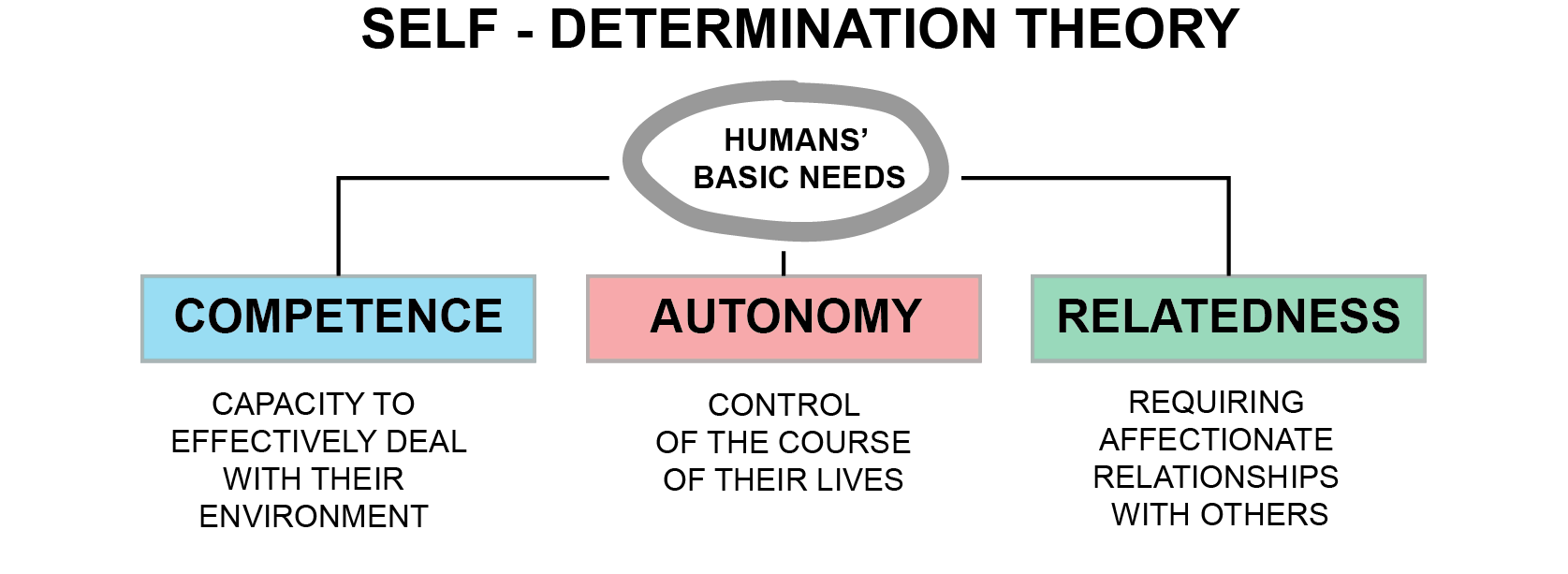
      Example of Self Determination Theory
    Example of Self Determination Theory

    CONCLUSION

    It is easy to forget that employees are one of the stakeholders in the organization. What is an organization without the people or the processes (created by said people) in it? As with any other stakeholders, you need to understand their needs and involve them in decision-making processes. As such, employee feedback is vital in developing the ideal team in any organization.

    Let us know what are your thoughts on this in the comment below and if you enjoy reading our articles, do join our community to get latest insights on gamification and L&D.
  • 5 Methodology Models to Measure the Effectiveness of Trainings: A Comprehensive Guide

    5 Methodology Models to Measure the Effectiveness of Trainings: A Comprehensive Guide

    Written by: Andrew Lau (CEO of Think Codex)

    As companies invest more in Learning and Development (L&D) programs to help employees acquire new skills and stay competitive, measuring the success of these programs becomes increasingly important. In this article, we’ll explore different methodology models that L&D professionals can implement and the critical metrics they need to measure to demonstrate the value of their programs. We start off by examining the most widely used learning effectiveness model – Kirkpatrick Model and then comparing other models against it. 

    Kirkpatrick Model by Donald Kirkpatrick

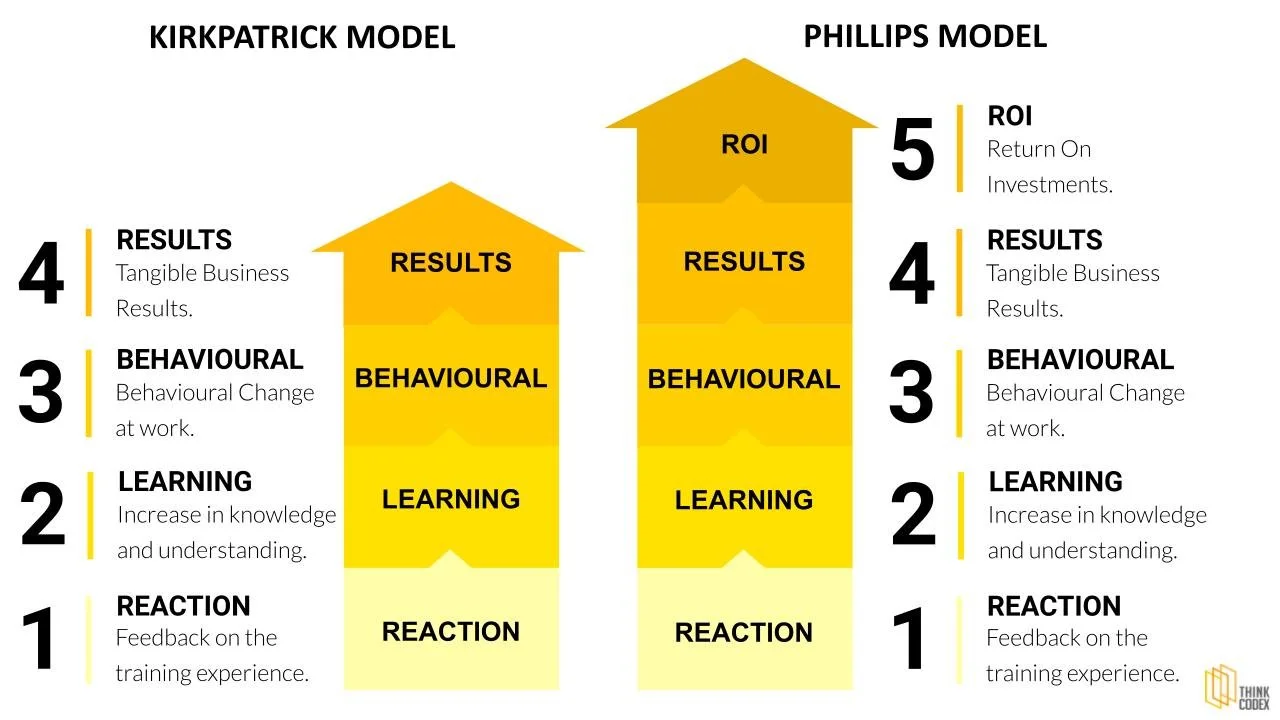
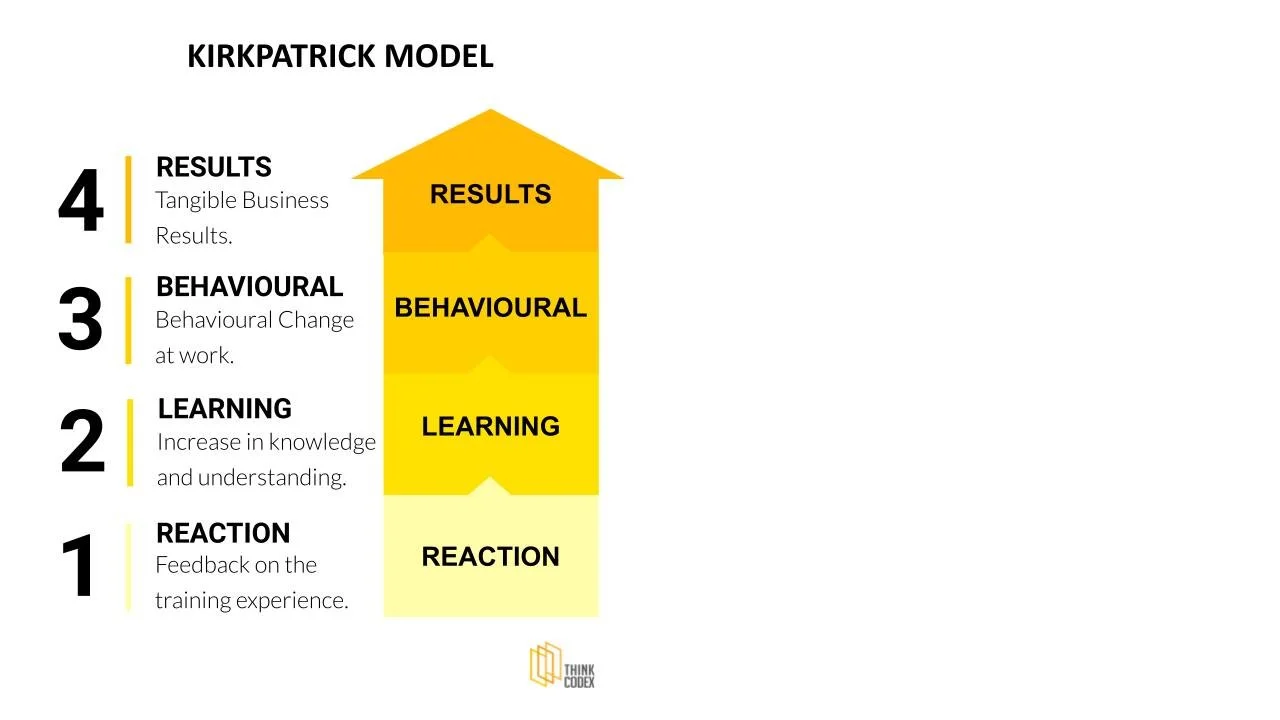
    The Kirkpatrick Model is one of the most commonly used methodology models in L&D. Developed by Donald Kirkpatrick in the 1950s, this model has four levels of evaluation:

    The Kirkpatrick Model is a valuable framework for evaluating the effectiveness of L&D programs. However, it’s important to note that the levels are hierarchical, and each level builds on the previous one. For example, learners are less likely to learn from the program if they don’t react positively to the program. They are less likely to change their behavior if they don’t learn from it. And if they don’t change their behavior, the program is less likely to positively impact the organization’s results.

    Comparative Methodology Models

    In addition to the Kirkpatrick Model, there are other methodology models that L&D professionals can implement to evaluate their programs:

    Phillips Model by Jack Phillips

    This model takes a step further by not just measuring Levels 1 to 4 which is similar to the Kirkpatrick Model but has a Level 5 measuring the return on investment (ROI) of the training program. The Level 5 ROI measurement uses data from L2 Learning, L3 Behaviour & L4 Results to create a model for finding out what monetary returns the organization is actually getting back from the training dollars spent.

    L1 – L4: Following Kirkpatrick Model
    L5: Return on Investment

    In the form of calculation,

    ROI (%) = (Net benefits of the training program / Total program cost)  x 100

    In the end, the Level 5 calculation comes up with a percentage (%) of ROI. While this is something that is indeed good to measure, there remain a number of challenges in implementing Level 5. Among them:

    1. High cost of effort to measure L5 – it takes extensive data collection and working with a number of stakeholders to get accurate data.

    2. Delayed Results – as a lot of effort is required, the results of L5 can often be delayed beyond the expected timelines of evaluation by stakeholders.

    3. Accuracy of measurement – while calculating, there are a number of assumptions made to put both tangible and intangible factors in focus. Some of these are subjective and up to interpretations depending on stakeholders. It’s important to note that this challenge appears in L4 of the Kirkpatrick & Phillips model to a lesser extent.

    4. Ideal but not pragmatic – while it’s great to have these measurements, very few training programs warrant L5 measurements. Jack Phillips himself noted that only 5-10% of training programs require measurements at L5. 

    5. Lack of data or cooperation from the customer – sometimes a customer just does not have the data required to make a L5 measurement as not all companies track the data of their operations. In the absence of such data, it is often a painstaking process of creating new data sets which can require additional work for stakeholders – which leads to resistance from them.

    Brinkerhoff Model by Robert Brinkerhoff

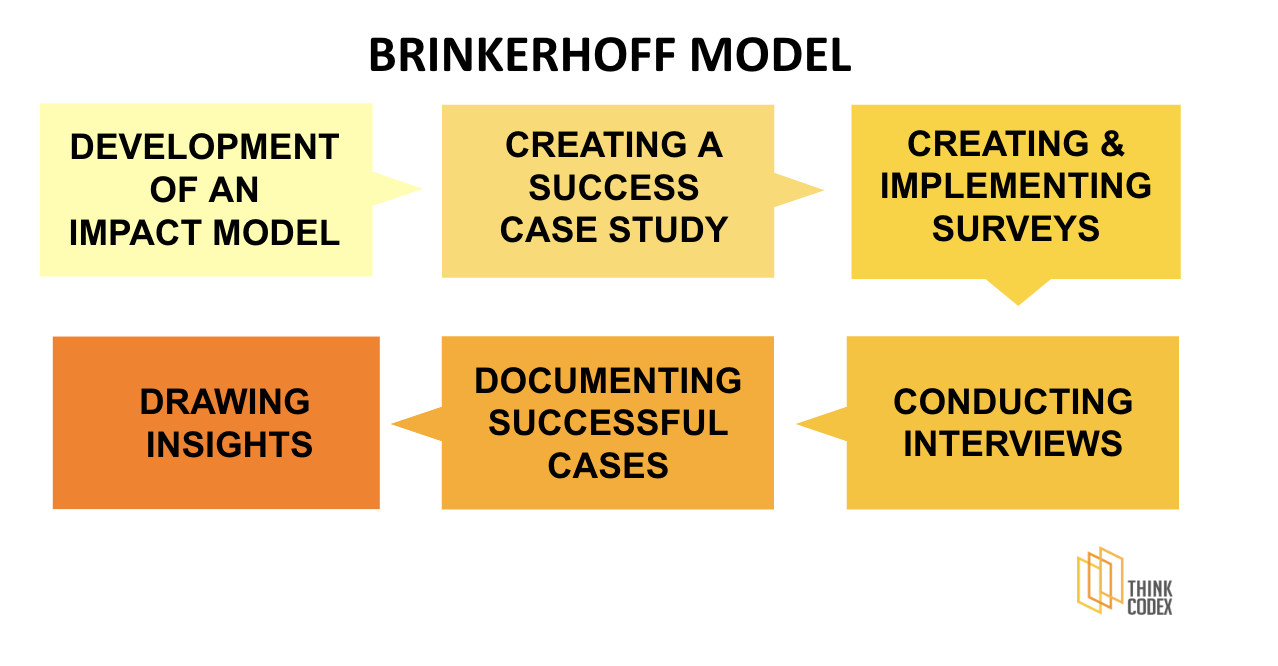
    This model is also known as Brinkerhoff’s Success Case Model (SCM) which emphasizes the importance of post-training support and reinforcement to ensure that learners apply what they have learned. Brinkerhoff states that traditional evaluation models such as Kirkpatrick & Phillips models were wrong to just focus on assessing the scope of a training’s effect. He says that the true measure of business results is from performance. SCM is not concerned about finding the average performance of training participants (Kirkpatrick & Phillips Models), but focuses on looking for extreme examples on both ends of measurements.

    As such this model measures the performance of the most successful participants and the least successful participants as use cases to understand how well did a learning program perform. The model looks at contrasts or extremes from both ends by seeking to understand 2 important areas:

    1. In a best-case scenario, how well did a program perform? This is derived from analyzing participants who show the most increase in performance after a training program.

    2. In a worst-case scenario, how badly did the program perform? This is derived from analyzing participants who may show the least or no increase in performance after a training program.

      Brikenhorff Model
    Brikenhorff Model

    How this model differs from Kirkpatrick & Phillips models is that it requires a few things:

    • The development of an Impact Model – the definition of what success looks like.

    • Creating a Success Case Study.

    • Creating & implementing surveys that can identify best-case and worst-case scenarios.

    • Conducting interviews.

    • Documenting successful cases.

    • Drawing insights, summarizing conclusions, and providing recommendations to stakeholders. 

    Kaufman Model by Roger Kaufman

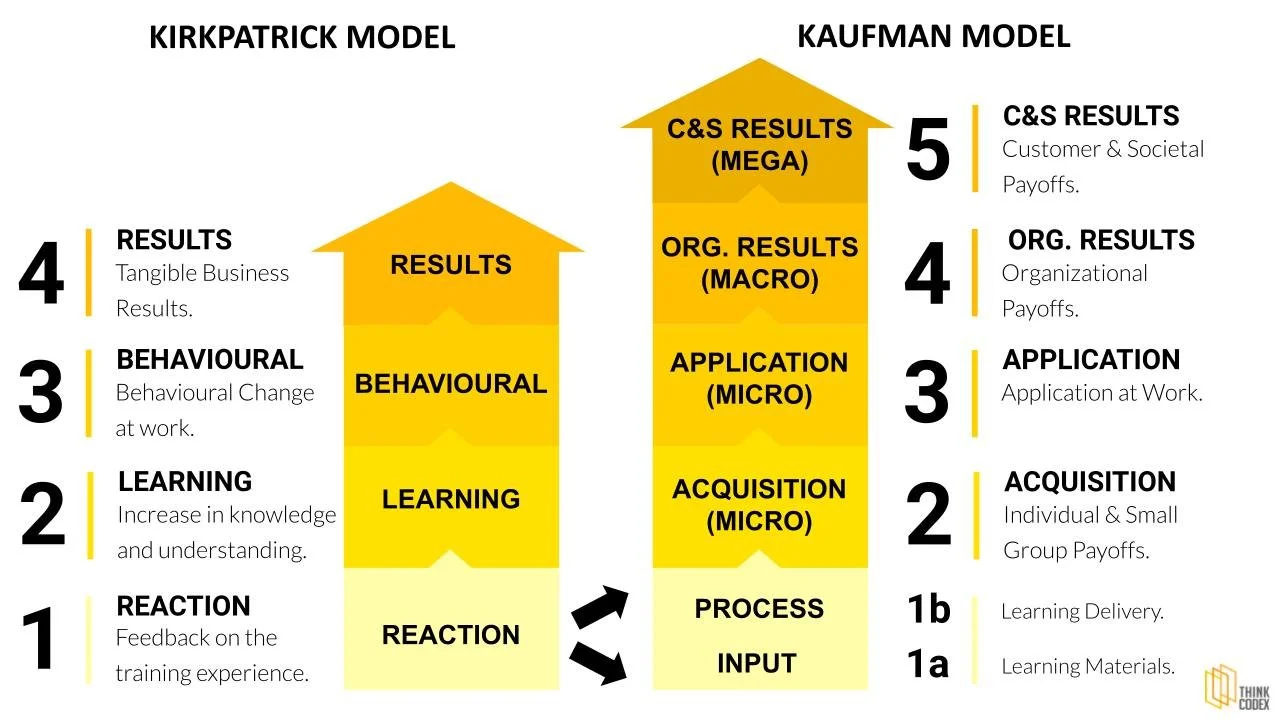
    This model is based on Kirkpatrick’s model and seeks to improve on it by looking at measurements at a detailed level (L1a and L1b) and big picture level (L5). It’s broken into 5 levels – though if counted, there are actually 6 levels.

    • L1a Input: This level covers training materials.

    • L1b Process: This level covers the delivery of the learning process.

    • L2 Acquisition (Micro): Individual & small group payoffs. Did the learner “acquire” the learning?

    • L3 Application (Micro): How well the participants utilize what they have learned on the job.

    • L4 Organizational Results (Macro): Organizational level payoffs – business results.

    • L5 Customer / Societal Results (Mega): Customers & Society payoffs – the 2 major stakeholders that an organization serves.

    Here are some key differences in the Kaufman Model:

    1. Group ‘clients’ into Micro (Individual & Small Group), Macro (Organization), and Mega (Customers & Society). This is found in L2, L3, L4 & L5.

    2. Divides Kirkpatrick’s Level 1 (Reaction) into Kaufman L1a (Input) & L1b (Process).

    3. Introduces a new Level 5 (Customer & Societal Results) which looks at a much broader picture.

    So what are the pros of the Kaufman model? Firstly the split in Kirkpatrick’s L1 (Reaction) breaks down the experience into 2 Kaufman factorssupporting materials (L1a Input) and delivery (L1b Process). This helps to isolate the issues of experience by looking at the quality of materials or the quality of delivery.

    What are the cons of the Kaufman model? While aspirational and good from a high-level view, trying to measure customer & societal payoffs (L5) require extensive effort, time, and budget. There’s also a high level of ambiguity as there are too many factors at play when we talk especially about customer & societal impacts. In fact, by measuring at L5, it’s hard to isolate these impact factors. This goes against Kaufman’s original intent in where else the goal in L1a & L1b was to isolate factors.

    So on one hand, the goal was to improve on Kirkpatrick’s model by isolation (L1a & L1b), L5 instead went against the same goal of isolation, thus giving conflicting views on the Kaufman Model.

    Where does Gamification Fit Into all these Models?

    Firstly, what is gamification? Gamification is the use of game phycology & game mechanics in non-game environments while achieving non-game outcomes. Such a use case is Learning & Development.

    Coming back to learning evaluation models, at the core – most models measure 4 things:

    • Experience – What was the experience like?

    • Learning – What did the person learn?

    • Behaviour – Is there a change in behavior at work?

    • Results – What individual, team, or business outcomes can be seen?

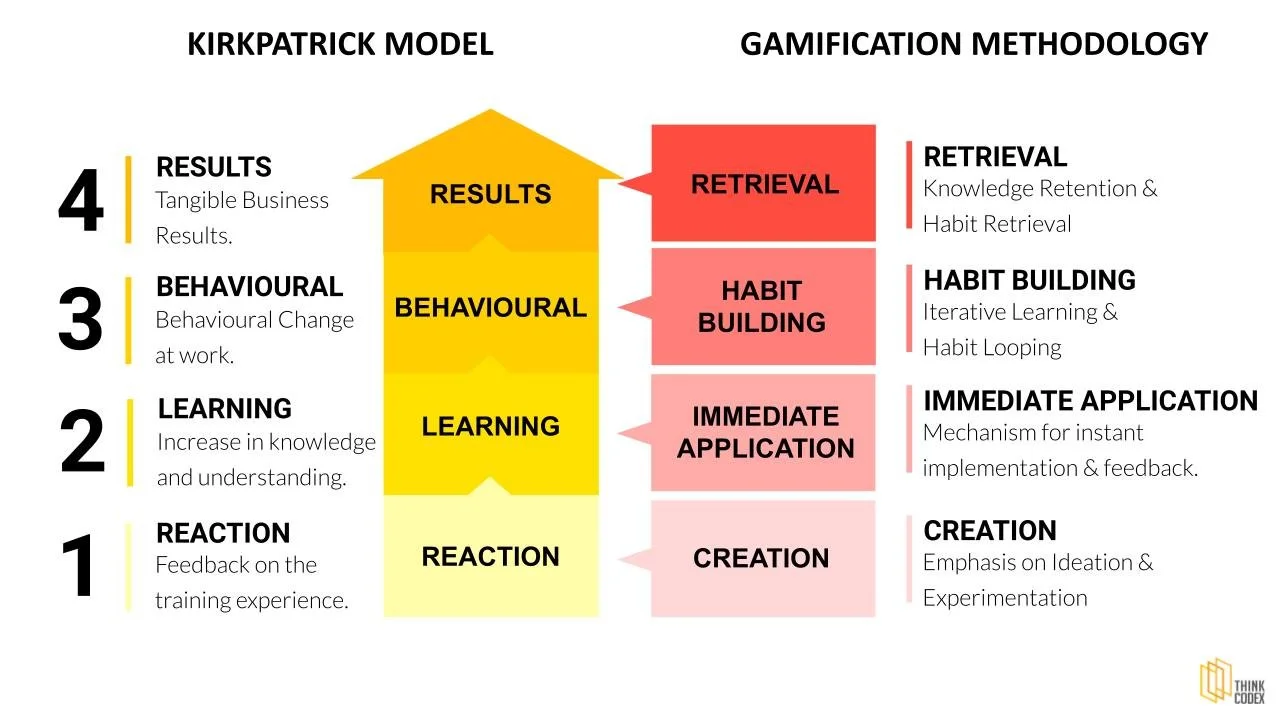
    Gamification’s methodology itself is not an evaluation model but instead is considered one of the most effective ways to drive impact at the levels of Experience, Learning & Behaviour which ultimately leads to Outcome. Let’s break it down to how gamification does that.

    • Experience – a great experience comes from the right type of engagement. Gamification and game-based learning use the methodology Creation (Ideation & Experimentation) as opposed to just Consumption (Information Download) found in most learning methodologies.

    • Learning – the most important learning comes from not just the acquisition of the knowledge but rather the application of the knowledge. The application of knowledge is typically where challenges and problems will appear. As such, it’s critical that application can happen within the learning session itself. Game-based learning methodologies such as Business Simulations (emphasis on Business) allow participants immediate application & feedback. Coupled with debriefs that tie it back to organizational context, learning becomes highly effective.

    • Behaviour – one of the challenges of getting a learner to change their current behaviors is their current habits. Often what is learned is forgotten or replaced with resistance to old habits. Gamification’s iterative and habit-looping techniques get the learner to learn new & better habits which are then overlaid on top of old habits. When learners are back at work, they then begin to practice what they learn from the new habits.

    Results – a changed behavior comes down to 3 factors:

    1. The ability to retain the knowledge learned

    2. The retrieval of new habits

    3. The confidence to try out what was learned.

    The confidence factor comes from the retention of knowledge and retrieval of new habits. If a learner can remember what they learned and also act out what they learned, then there is confidence to behave in a new way – which then leads to business results.

    How to Choose the Right Model

    1. Do you have data in place for measurements? If you know where the data is, then a number of models might work.

    2. Do you want to create new data sets for measurements? This can often be a complex and long process.

    3. Do you have the cooperation of the different stakeholders? Measurements not only require input from the HR professional but stakeholders from the business. Many often have no

    4. Do you understand the different models? Do you know what is measurement required and how success is defined in each of the models and how it will fit into your organization?

    5. Does the effort required makes it worth getting the results? In essence, this is a cost-benefit analysis. Is the results worth the trouble of going through the measurements – some of which require extensive effort.

    Using Different Models For Different Learning Programmes

    Should we use different models to measure different training programs? From an outcome perspective, this is ideal. From a practical perspective, the costs may far outweigh the benefit. Our recommendation is using different models should be determined by:

    1. What type of results do you really need?

    2. What type of effort are you willing to put in?

    3. What type of monetary cost are you willing to invest?

    4. What type of support do you have in the organization?

    5. What level of expertise do you or your vendor have on the different models?

    Why Measure L&D Metrics?

    Before delving into the different methods for measuring L&D metrics, it’s important to understand why it’s necessary. Here are some key reasons:

    • Measuring L&D metrics helps organizations understand the effectiveness of their training programs and identify areas where improvement is needed.

    • By measuring the ROI of L&D initiatives, organizations can justify the investment in these programs and secure funding for future initiatives.

    • Improve employee engagement which can lead to increased productivity and reduced turnover.

    • Increase employee performance because when they have the skills and knowledge they need to do their jobs well, they are more likely to perform better.

    Measuring the effectiveness of L&D programs is crucial to ensure that they are achieving their intended goals. By using key metrics and frameworks such as the Kirkpatrick Model, organizations can get a better understanding of the impact of their L&D programs. Subscribe to Think Codex’s content and explore our other resources to learn how to measure their effectiveness and achieve your goals using frameworks like the Kirkpatrick Model.

  • 5 Strategic Steps to Align Your L&D with Business Success

    5 Strategic Steps to Align Your L&D with Business Success

    Written by: Raveena Elizabeth

    We’ve seen it all too often. L&D is seen as a support function (a.k.a backup) or a rapid response team (aka fixer) when the business suddenly needs to manage a people gap problem. L&D can be viewed as a secondary infrastructure and called upon only when help is needed. It doesn’t have to be like this. L&D professionals need to understand business strategy and then create an aligned L&D strategy for the business’s success.

    Enter the L&D Strategy and it’s 5 steps

    Do we really have clarity and know the business strategy and needs? Most of us get our understanding from the few lines written inside a Training Needs Analysis document.

    A learning and development (L&D) strategy is a comprehensive plan that outlines how an organization will meet its professional development needs and achieve its business objectives. It is time-bound, meaning it has a specific time frame for completion, and sets measurable goals and objectives. Failure to do this just makes the L&D function out of scope, outdated, and an unwanted distraction from “real” work.

    The goal of an effective L&D strategy is to provide employees with the necessary skills and knowledge to improve their performance, enhance their engagement, and contribute to the overall success of the business. This blog post will explore the different types of business goals and how L&D teams can design and implement an effective learning and development strategy.

    Step 1:  Understand the Types of Business Goals

    The first step in developing an effective L&D strategy is to understand the types of business goals that an organization can have. These goals can be broadly categorized into two kinds: business-related goals and employee-related goals.

    How To
    Often the need of the organization will include both in a single intervention by L&D. Here’s the key, even when it seems like a simple request in an email, always schedule a call with the stakeholders – decision makers, potential participants, and perhaps any other people that the training can impact. Often we will find that there is a notable difference between what is written in an email and what is revealed in a meeting. The details you get in the meeting help you to craft a more focused and accurate L&D solution. Don’t skip the meeting!

    Once you gain clarity, it’s time to move on to Step 2.

    Step 2: Conduct a Skills Gap Analysis

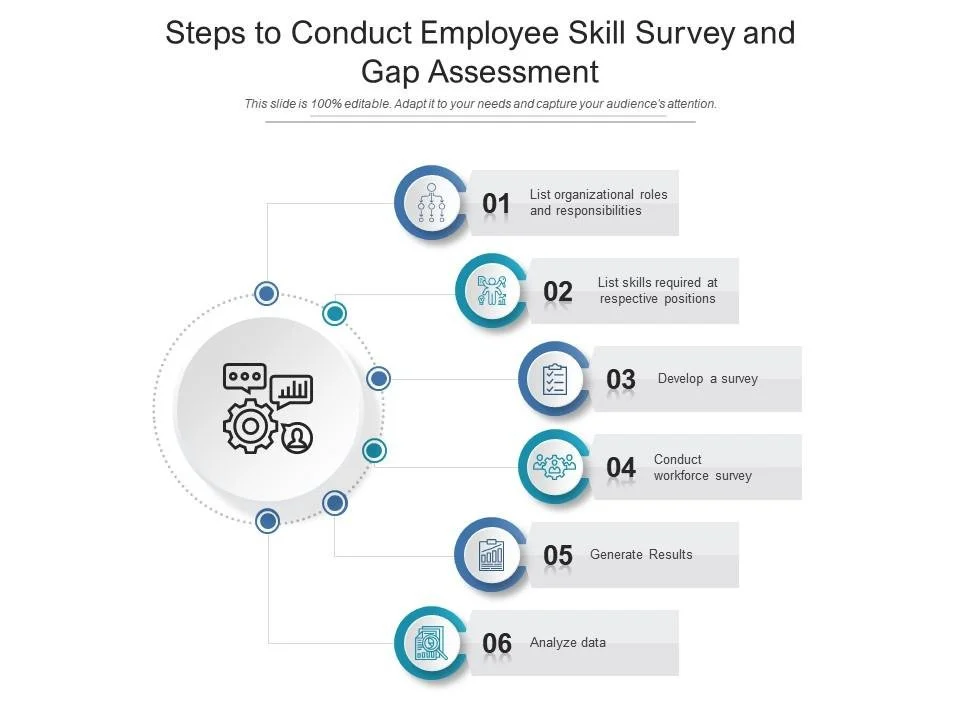
       Steps to conduct employee skill survey and gap assessment
    Steps to conduct employee skill survey and gap assessment

    This involves evaluating the skills and knowledge required to achieve business goals and comparing that to the skills and knowledge currently possessed by employees. The analysis can be conducted using a variety of methods, such as Training Needs Analysis (TNA), surveys, assessments, focus groups, or interviews. Once the skills gap has been identified, organizations can create targeted training and development programs to close the gap.

    How To
    It’s crucial to ask BOTH the employee what they view as their gap and also their line manager to see what is the gap of the employee. Do not communicate the results of the other party to each of them until both of them have completed this process. This is to prevent bias and also groupthink between both the results.

    Step 3: Design Learning Programs

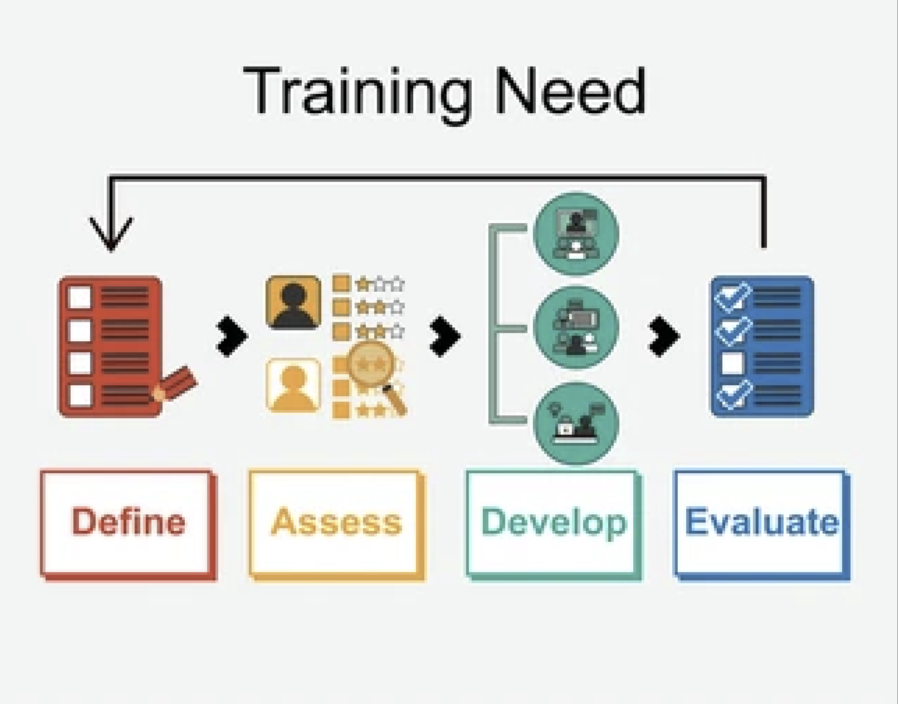
     Training need analysis vector
    Training need analysis vector

    Effective learning programs should be designed in a way that aligns with business goals and addresses the specific needs of the workforce. This involves using various learning methods such as Instructor-Led Training (ILT), eLearning, On-the-Job Training (OJT), Gamification, Simulations, Mobile Learning, and Social Learning to cater to different learning styles and ensure that employees can apply the new knowledge and skills to their jobs.

    How To
    Remember it’s not the type of training that matters – that’s the method only. Use whatever method that gives the best results. Some methodologies may be more suitable for high engagement and practical applications such as gamification based simulations.

    Step 4: Measure and Evaluate L&D Effectiveness

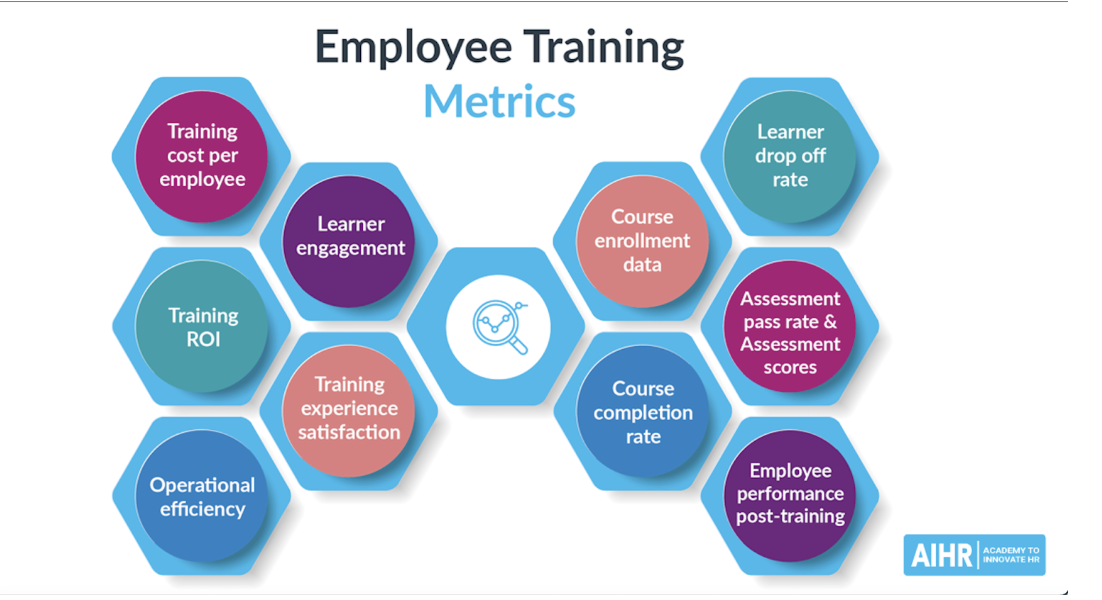
     Source by  AIHR
    Source by AIHR

    To ensure that L&D programs are effective and contribute to business goals, this can be done through various methods, such as surveys, assessments, and performance evaluations. This helps identify areas where improvements can be made and ensures that the organization is getting a return on its investment in L&D.

    Step 5: Communicate and Collaborate with Key Stakeholders and Measure and Evaluate L&D Effectiveness

    Effective communication and collaboration with key stakeholders are critical to the success of aligning L&D strategy with business goals. This includes working closely with senior leaders, managers, and employees to ensure that the training and development programs are aligned with the overall business strategy. Also, help to identify areas where improvements can be made and ensure that L&D efforts are relevant and practical.

    To illustrate the importance of aligning L&D strategy with business goals, let’s take a look at a real-life example (studied by Deloitte, 2023) A major German information and communications technology company faced several challenges: A lack of highly demanded IT skills, a low turnover rate, a high average age of the workforce, and insufficient business performance. 

    To overcome these challenges, the management team of the company decided to kick off a large-scale agile transformation that involved over 60% of its total workforce. By re-up-skilling existing staff into agile roles and adopting agile methodologies, the company not only significantly increased its business performance but also developed a thorough learning culture within the organization that made learning in the flow of work a key pillar of its strategy.

    This case study highlights the importance of aligning L&D strategy with business goals. The IT company recognized the need to re-skill its workforce to meet the demands of the market and improve business performance. By aligning L&D initiatives with the company’s strategic goals, the company was able to achieve a successful transformation and develop a culture of continuous learning within the organization.

    However, if the company had not implemented an L&D strategy that aligned with its business goals, it may have continued to struggle with a lack of skills and insufficient business performance. It may have also missed the opportunity to develop a learning culture that could drive innovation and growth.

    In conclusion, it’s crucial for organizations to align their L&D strategy with their business goals to achieve success. However, it’s equally important to continuously evaluate and update the strategy as the business landscape evolves. I encourage you to take action and regularly assess your L&D strategy to ensure it remains aligned with your business goals and helps drive your organization’s success.

    Need our expertise in helping you to achieve your business goals? Click here for a free consultation!

  • How To Take The Role of Games In Business Seriously

    How To Take The Role of Games In Business Seriously

    Games have always been seen as an activity for entertainment and leisure, but not for work. Here we explore the place of games in the business world.

    By Andrew Lau

    Everyone has played games. It’s something we experience as part of growing up. Games help us to learn, to avoid repeating mistakes, to choose the right friends, to win graciously, and to lose well. These very things that happen during childhood are what we can also apply to our working lives.

     Gamifying business goals makes achieving them so much more desirable
    Gamifying business goals makes achieving them so much more desirable

    Lately, gamification has come into business in a big way. More and more companies are making time to play, whether to increase employee engagement through team-building activities, or to facilitate learning in a business environment.

    As someone who helps organizations develop their employees’ potential, I often find myself telling bosses that “people learn by doing”. When you need to coordinate with others to learn new concepts, change mindsets, or produce results, then reading slides and memorizing manuals are not effective.

    This is why I’ve spent most of my career building business simulations that help colleagues experience and resolve real-life challenges in a safe environment.

    Business simulations are powerful. They can be built to isolate and target specific issues. Most importantly, you can make mistakes and learn without impacting the real business world.

    Engagement Vs Efficiency: Why does Gamification work?

    For most people they often see the outward representation of games such as cards, tokens, badges, avatars, and leaderboards. However, the real secret lies behind the design of the gamification system.

     Behavorial design - Photo by Startup Stock Photos from Pexels
    Behavorial design – Photo by Startup Stock Photos from Pexels

    There are typically 2 types of system design in the world:

    i. Function-centered design creates systems with the end goal of efficiency. However, even though this system is efficient, it does not mean people are motivated or engaged to use it. Most systems in a business are designed this way.

    ii. Human-centered design on the other hand. focuses on user engagement and motivation instead. It makes people want to use a system and derive personal meaning from their interaction. The question that should be asked during design is “What do we want to make the user feel?” (Engagement) as opposed to “How can we make things faster?” (Efficiency)

    You’re Happier When You Play

    E-Learning is a classic case of function-centered design. Internal e-learning platforms are an efficient way to distribute content among employees. However, it’s usually not designed to actually motivate or engage your people to WANT to learn.

    Here’s how most people approach e-Learning.

    First we go for the quiz, and if we pass (hurray!), we are deemed to have learned the subject. If we fail, then we go through the drudgery of re-watching the videos, only most times, we don’t.

     How engaging is e-learning really?
    How engaging is e-learning really?

    We turn on the video, make a cup of coffee and chat with our colleagues or attend to our emails. We wait for the time when we can take the quiz again. If we fail, repeat coffee and emails till we get it correct.

    This is what learning through a function-centered designed system could look like.

    Learning through a human-centered design system is hugely different. The most obvious difference is that there is usually a big dose of gamification. Imagine if learning in organizations was geared through completing business missions and quests. The only way to complete missions would then be by applying theories and tools.

    Users also rapidly ideate and prototype their ideas in a safe environment. They use iteration to keep getting better at a competency. By the end of a learning session, their repeated actions would have formed the building blocks of new behaviours, ultimately bring results to organizations.

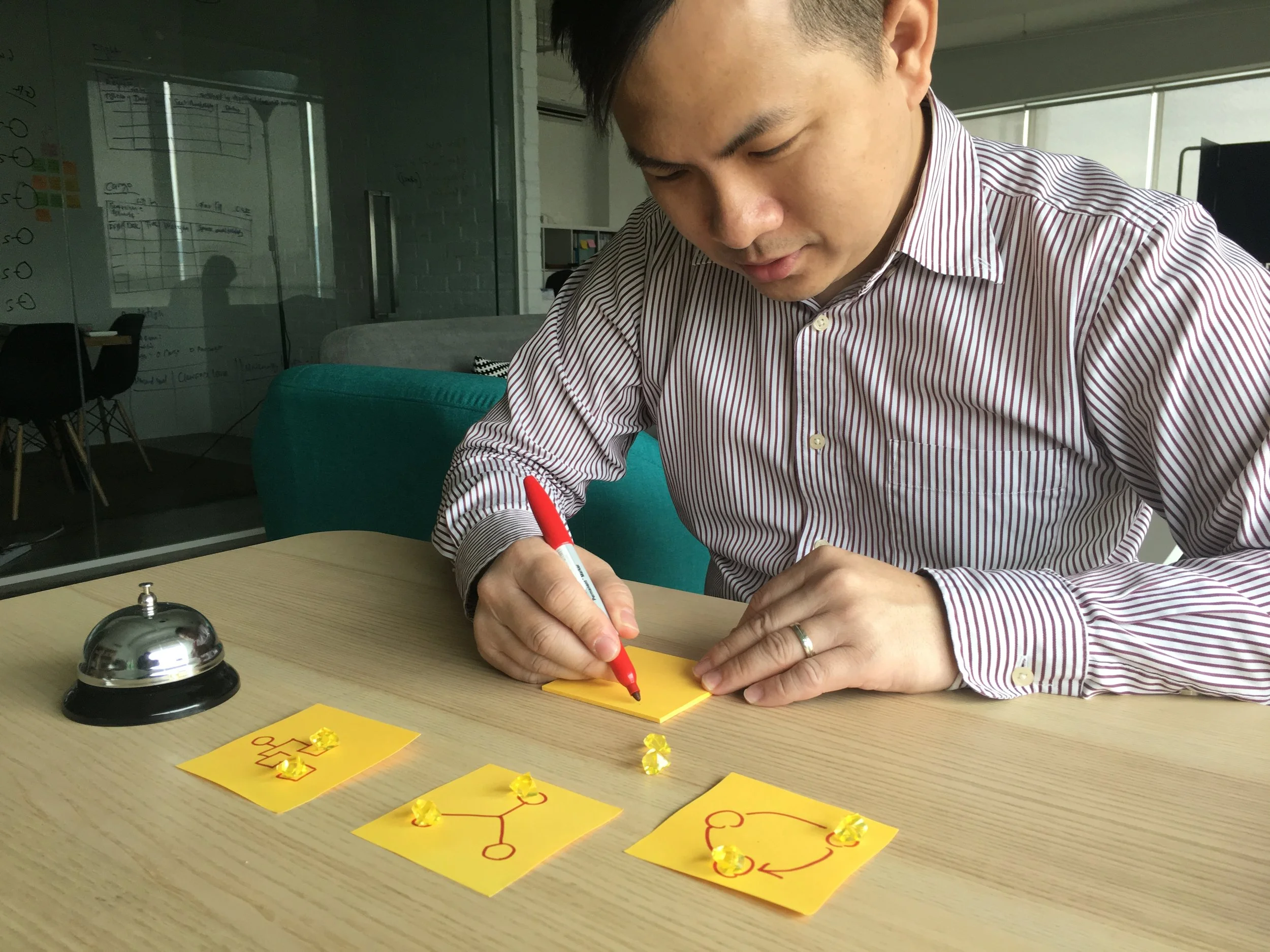
     Think Codex CEO Andrew Lau prototyping human-centered design concepts
    Think Codex CEO Andrew Lau prototyping human-centered design concepts

    Most importantly, users have a lot of fun while gaining insights.

    Gamification truly taps into the core of human-centered design. It’s about designing a system that gets your customers, employees, and even yourself, to be both extrinsically and intrinsically motivated toward desired actions.

    End Game

    So where does this leave us?

    Everybody loves games and are drawn to it because it connects us to who we are as humans.

    We are driven by:

    1. A positive sense of meaning, empowerment, social influence, accomplishment and ownership.
    2. A negative sense of unpredictability, scarcity and avoidance.

    All these drive human engagement and motivation.

    So, to drive results, the choice is simple. All you need to do is press Play.


    Andrew Lau is the CEO of Think Codex, a Learning Gamification Organization that believes the best way to get results is through human-centered systems. You can write him at andrew.lau@thinkcodex.com
     

  • Training & Development: Keeping your Millennials Engaged At Work

    Training & Development: Keeping your Millennials Engaged At Work

    By Bryan Woo, Simulation Designer

    As many organizations start to diversify themselves with more and more millennials, who will soon grow to dominate the workplace, it brings about an interesting challenge: how do you develop and keep your best millennials engaged at work?

       2016: Deloitte found that Millennials hold 20% of leadership roles
    2016: Deloitte found that Millennials hold 20% of leadership roles

    Research by Gallup has revealed that only 39% of millennials strongly agree that they have learnt something new within the last 30 days, as well as only 29% of millennials being engaged at work.

    Millennials that feel they have learnt something new

    Millennials that feel they are engaged at work

    The results are rather alarming, considering the fact that most organizations within the top quartile of employee engagement have been linked to 17% more productivity, 10% better customer ratings, as well as 21% more profitability as compared to their bottom tier counterparts.

    Interestingly enough, a fun fact about the average millennial is that they spent a staggering 2,000 – 3,000 hours reading books, and 3x that amount playing games before turning 21. Based on those numbers, we can be certain that millennials are very familiar to gameplay & game mechanics. Which brings me to my next point: What if you can tap into a millennial’s familiarity with games and carry that over into his or her learning and development, while at the same time, keeping them engaged at work?
     

    Enter, gamification.

    Gamification, in its simplest definition, is the process of using the fun & engaging elements found in games and applying them to non-game, real world environments in order to influence behaviour. It has gained popularity in use especially in classroom and other learning based environments.

    What makes gamification a unique learning approach. is that it is considered a form of “Human-Focused Design”, defined by Yu-kai Chou, an expert in gamification, as a design process specifically revolving around the learner in mind. This process places emphasis especially on the learner’s feelings, motivations, as well as engagement.

      Recapture the joy of learning as a kid. - Photo by  Ben White  on  Unsplash
    Recapture the joy of learning as a kid. – Photo by Ben White  on Unsplash