Strategic L&D in Times of Change: How Think Codex Can Accelerate Your Success
Companies across industries are facing unprecedented economic challenges. Layoffs, budget cuts, and shifting priorities can make focusing on long-term resilience difficult. However, neglecting the development of a skilled and adaptable workforce during these times carries significant risks.
This is where Think Codex, a leading provider of game-based L&D solutions, can help. We transform how organizations approach change, leadership, and team dynamics, empowering your people to navigate uncertainty and drive success.
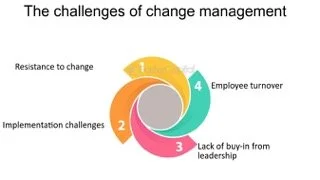
Pain Point 1: The Challenge of Change Management
Credit infographic of the challenges of change management: Faster Capital
Restructuring and downsizing place immense pressure on employees. To thrive, they need adaptability, strong communication, and the ability to collaborate effectively across newly formed teams.
Think Codex’s change management simulations immerse employees in real-world scenarios, developing the problem-solving skills and resilience needed during periods of flux. To learn more about our approach to change management, check out our ThinkAdapt blog post
Pain Point 2: Internal Hiring – Where Think Codex Fits
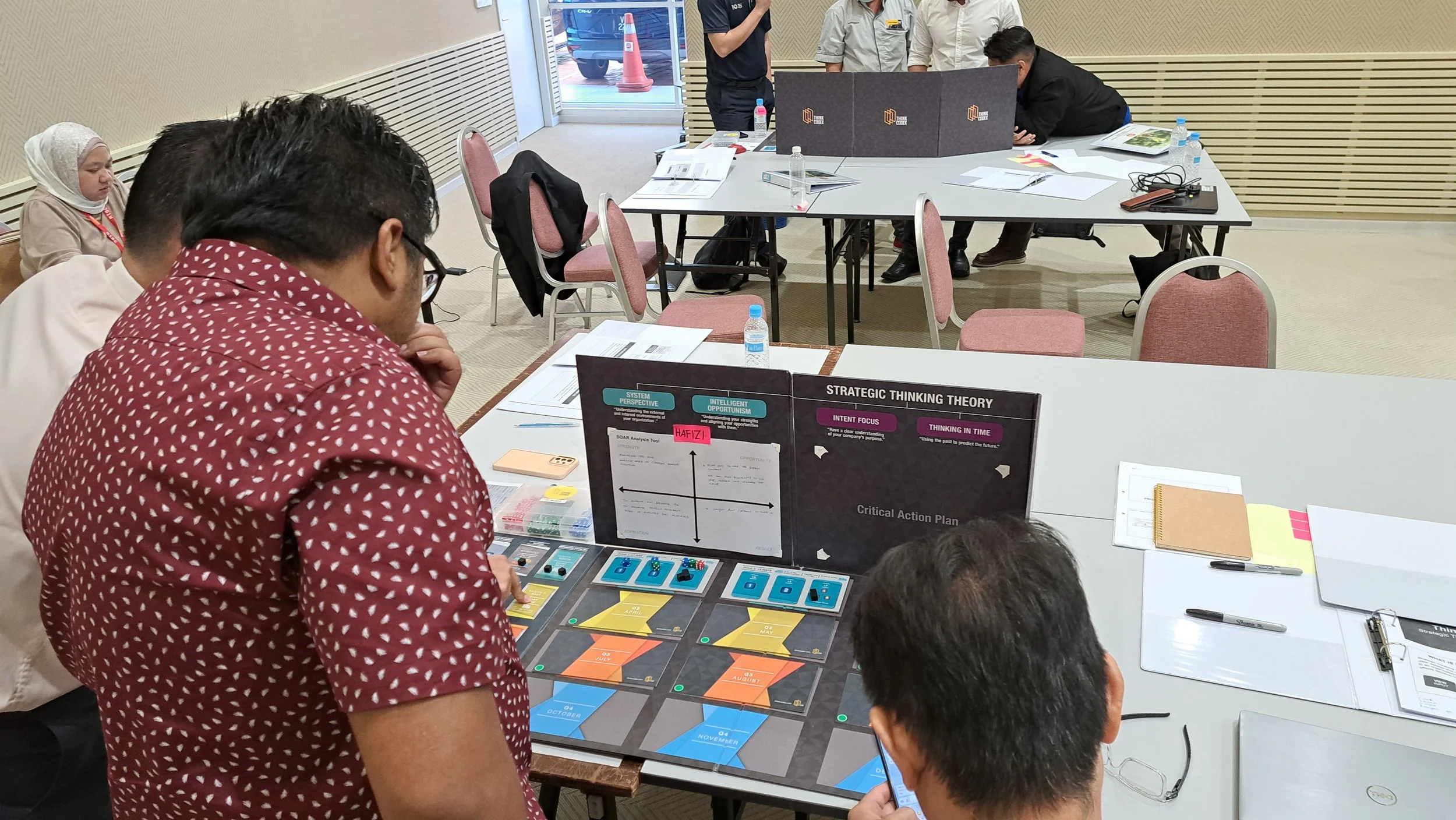
Sime Darby’s employees are immersed in a Think Codex’s leadership development simulation, collaborating and problem-solving.
Understandably, many companies are prioritizing internal promotions and upskilling. Think Codex accelerates this process with targeted leadership development programs designed specifically for MNCs. We bridge the gap between current skills and new roles, building a pipeline of capable leaders ready to step up with confidence.
Additionally, our team-building simulations foster the cross-functional collaboration essential for a smooth post-restructuring transition.
The Think Codex Advantage
Engagement and Impact: Our game-based approach drives higher engagement and knowledge retention compared to traditional training methods.
Flexibility: Choose physical sessions for high-impact team experiences or explore our virtual solutions for scalable, remote L&D.
MNC Expertise: We understand the unique needs of MNCs and conglomerates, offering tailored programs across diverse industries like banking, FMCG, oil & gas, and more.
Let’s be honest, most corporate training programs could use a serious energy boost. Dry presentations, endless compliance modules… it’s no wonder employees tune out. That’s where gamification comes in – it has the power to transform your training from snooze-fest to something people look forward to.
What is Gamification (and Why Should You Care)?
Gamification isn’t about turning your company into a giant video game. It’s about using game-like elements – think points, badges, challenges, and competition – to make learning more fun, motivating, and effective. Here’s the magic: our brains are wired to respond to these elements, making learning feel more like play and less like work.
Proof it Works: Deloitte’s Success Story
Don’t just take my word for it. Global consulting giant Deloitte revamped their leadership training with their gamified Leadership Academy. This platform uses simulations, challenges, and storylines to immerse employees in real-world leadership scenarios. The payoff? Skyrocketing completion rates and a stronger pipeline of future leaders. Check out the details on Harvard Business Review.
2 Ways to Level Up Your Training with Gamification
1. Content Gamification: Make the Material Fun
Break it Down: Ditch the long lectures. Use quizzes, short challenges, or interactive scenarios to test knowledge after each bite-sized chunk of learning.
Choose Your Adventure: Put learners in the driver’s seat with scenario-based learning. Let their choices and decisions impact the outcome – just like a real-life work situation.
Progress = Satisfaction: Visualize progress with progress bars or level-up systems. This sense of accomplishment keeps learners coming back.
2. Performance Gamification: Reward the Right Behaviors
Points for Progress: Award points for course completion, skill demonstrations, or active participation.
Badge of Honor: Create badges to recognize achievements or milestones.
Friendly Competition: Leaderboards add excitement and a little healthy competition to boost motivation.
How to Get Started (and Prove it’s Worthwhile)
Set Clear Goals: What do you want your training to achieve? Gamification is most powerful when it targets specific outcomes.
Choose the Right Game: Points, badges, or something else? Select mechanisms that fit your goals and resonate with your employees.
Make it Real: Tie rewards and challenges to job skills and company goals.
Track the Wins: Measure completion rates, knowledge gains, and real-world performance improvements to demonstrate the ROI of your gamified training. For in-depth guidance on this, check out this guide.
If you’re wondering if gamification is the right move for your team, let’s chat and explore the possibilities!
Leader in a group discussion with teammatesOpen communication between leader and teammates
In a world where leaders often grapple with the complexities of authenticity, purpose, and innovation, understanding your core motivations can fundamentally redefine leadership. Many leaders face the challenge of navigating their roles without a clear sense of purpose, leading to decision fatigue, lack of direction, and diminished impact. Through the lens of Oprah’s authenticity and Steve Jobs’s innovation, we’ll explore how deeply comprehending what drives you can not only clarify your leadership path but also significantly amplify your influence and effectiveness.
Credits to shutterstock of Oprah Winfrey picture
Oprah’s Secret: Connecting Through Authenticity and Purpose
I had this epiphany while rewatching an old Oprah episode (yes, I still do that). It hit me – her strength was not just about the topics she chose but about her unwavering commitment to her ‘why.’ She connected, she inspired, and she led with her truth. Isn’t that what we all strive for?
Oprah’s journey exemplifies authenticity and purpose-driven leadership. By sharing her vulnerabilities and triumphs, she built a profound connection with her audience, teaching us the value of embracing our true selves.
Case Study Examples
Credit to Amazon Prime for The Oprah Winfrey Show picture
In 1986, Oprah took a significant risk by transitioning her successful local talk show into a nationally syndicated program, “The Oprah Winfrey Show.” At a time when daytime talk shows were sensationalist and tabloid-like, Oprah shifted the format to focus on literature, self-improvement, and spirituality.
Embrace your unique voice and vision. Oprah’s success stemmed from her authenticity and willingness to diverge from the norm. This case highlights the importance of staying true to one’s values and vision, even when it contradicts popular trends. Leaders should trust their instincts and remain authentic to their vision.
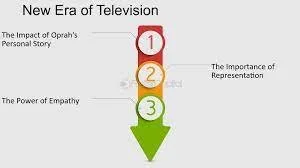
Credit to Fastercapital.com for How Oprah Redefined Television infographic
Facing initial low ratings and significant financial losses, the launch of OWN in 2011 was deemed a failure by many critics. However, Oprah persevered, reevaluating and restructuring the network to better align with her vision and values.
Persistence in the face of failure. Oprah’s ability to reassess and realign her strategies under pressure demonstrates the strength of a clear ‘why.’ Leaders can learn that setbacks are not endpoints but opportunities for growth and realignment.
Reflective Question
How can you leverage your authenticity to inspire and connect with others more deeply?
Credit to Alamy of Steve Jobs picture
Steve Jobs: Revolutionizing Technology with a Vision for Perfection
The visionary co-founder of Apple, offered a leadership model distinctly his own yet profoundly committed to excellence, setting him apart from other icons like Oprah. His relentless pursuit of perfection in user experience wasn’t just about inventing new technology; it was about revolutionizing how we interact with the world, seamlessly blending art with technology in unprecedented ways. This ambition drove the creation of groundbreaking innovations such as the iPhone and iPad, each fundamentally transforming industries upon their release.
Credit to Business Insider of The First iPhoneAccess to music on iPhone
The revolutionary design of the first iPhone, with its single button and touchscreen interface, marked a significant departure from the prevailing keypad-based phones, highlighting Jobs’s commitment to user-centric design.
Bold visions and user-focused innovation can redefine industries. Leaders should dare to explore new territories with a clear focus on user needs.
Reflective Question
How can I prioritize user needs to disrupt and redefine standards within my industry?
In a bold move, Jobs introduced a device that combined a phone, an iPod, and an internet communicator. Venturing into the mobile phone market, Apple, under Jobs’s leadership, demonstrated unparalleled innovation and courage.
Leadership requires the courage to innovate and the vision to see beyond the current market landscape. The iPhone’s success illustrates the value of exploring uncharted territories, guided by a clear vision of the future.
Collecting data on user experience
The Power of Vulnerability and Vision in Leadership
Both Oprah and Jobs leveraged their vulnerabilities to forge deeper connections and drive innovation. Sharing struggles and maintaining a clear vision even under pressure are hallmarks of their leadership styles.
Credible and great leader walk
Strategies to Uncover Your Leadership Why: A Step-by-Step Guide
Discovering your leadership “why” is pivotal for navigating your path with conviction and purpose. Here’s how you can start this journey:
Reflect on Your Core Values
Identify the principles that are non-negotiable in your life and work. These core values are the compass that guides your leadership “why.”
Assess Your Greatest Achievements
Consider your most fulfilling accomplishments. Understanding what motivated you in these moments can illuminate your underlying motivations.
Seek Feedback
Engage with colleagues or mentors to gain perspectives you might overlook. External insights can offer a fresh look at what drives you as a leader.
Experiment with Different Approaches
Leadership is not one-size-fits-all. Exploring various styles can help you find the approach that resonates most deeply with you.
Journaling and Mindfulness
Regular introspection through journaling or mindfulness practices can offer clarity on what influences your decisions and actions.
Incorporating these strategies with lessons from Oprah Winfrey and Steve Jobs, you can carve out a leadership path that is uniquely yours, driven by a clear and personal “why.”
Exploring Various Leadership Styles
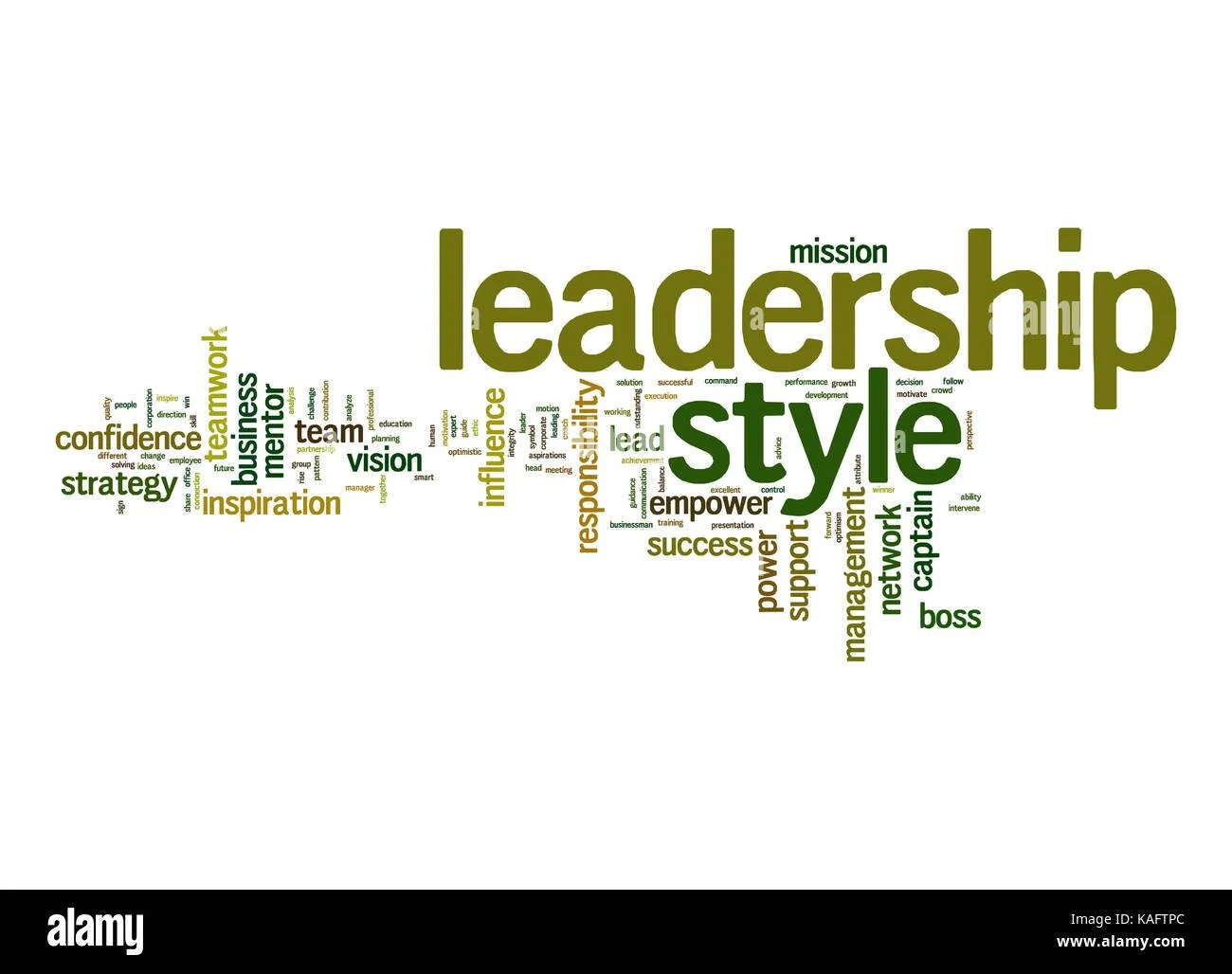
Credit to Alamy for the leadership keywords
Leadership manifests in myriad forms, each powered by a distinct “why.” Consider Elon Musk’s forward-looking vision compared to Jacinda Ardern’s empathetic governance. These contrasting styles show that leadership effectiveness is not about the “why” itself but how authentically you align your actions with your core motivations.
Understanding the diversity in leadership styles enriches your perspective, allowing you to appreciate the varied paths to effective leadership. Whether driven by innovation, like Steve Jobs, or social responsibility, like Jacinda Ardern, the authenticity of your “why” is what defines your impact as a leader.
Tying It All Together: Your Takeaway
As you wrap up your day (and this blog), take a moment to ponder your ‘why.’ It’s not just a one-off exercise; it’s a continuous journey. Whenever in doubt, their legacy is there for inspiration.
Oprah Winfrey and Steve Jobs exemplify that understanding and living your ‘why’ can lead to profound leadership success. Their stories encourage us to find our own path, guided by authenticity, innovation, and purpose.
Discover More with the Leadership Micro Talent Program
But wait, there’s more! If this conversation about leadership and finding your ‘why’ has sparked something in you, I’ve got just the thing. Check out the Think Codex’s Leadership Micro Talent Program here to discover how our program can help you and your leadership team discover and refine their ‘why’.
In simple terms, sustainability means running a business in an ethical, responsible, and forward-thinking way, considering the well-being of future generations and the environment. Companies often achieve sustainability through ESG measures, which include environmental efforts like reducing greenhouse gas emissions, social practices such as fair working conditions, and governance measures like transparency and Diversity, Equity, and Inclusion (DEI) initiatives.
For investors and financial professionals, ESG is the key focus. It serves as a set of criteria to gauge a company’s dedication to ethical and sustainable practices. Now, let’s delve into these three ESG components.
Risk Management, Mitagation, and Compliance: Play a vital role in ensuring ethical standards and legal mandates are met while also minimizing operational risks. Proper employee training can help them handle industrial waste safely, reducing hazards and pollution while complying with waste management laws. This prevents financial loss due to penalties for non-compliance.
Innovation and Financial Performance: ESG correlates with higher equity returns and reduced downside risk. ESG-conscious companies are more adaptable to regulatory and environmental changes, driving innovation, lowering operational costs, and enhancing efficiency.
Reputation and Stakeholder Relations: Transparency in sustainability practices boosts a company’s reputation and stakeholder confidence. ESG measures instil investor confidence and consumer appeal, leading to better access to funding and corporate expansion.
Consumer Appeal: Conscious consumerism is on the rise, with people actively seeking out eco-friendly companies. This shift in consumer behaviour highlights the growing importance of ESG measures. Companies recognized for their sustainability efforts, like Apple, have seen increased consumer appeal. For instance, Apple’s commitment to carbon neutrality and reduced plastic packaging have contributed to its positive image among consumers and investors alike.
Think Codex’s Role in ESG Integration
We actively engage with the ESG movement, propelling change within the financial landscape. Our strategic initiatives include:
ThinkBuild Simulation
Integration of ESG into ThinkBuild Sessionswith AIA, ensuring sustainability is integral to shaping financial strategies. Click here to find out more how it works!
We are dedicated in promoting sustainability and building a better future. To achieve this, we have formed an exclusive partnership with Sustainability Unlocked, which is the leading learning platform in the UK for sustainability education. As their regional partnership with exclusivity in Malaysia, we are proud to offer their on demand sustainability and ESG courses providing worldwide expertise and learning opportunities to professionals and businesses. To learn more about Sustainability Unlocked, please click here!
Embrace ESG for Future Success
ESG is not just a timely trend; it’s a strategic imperative. As businesses worldwide embrace ESG principles, financial professionals must explore Sustainability Unlocked courses and initiate dialogues with organizations like Think Codex. Ultimately, I believe that ESG will become more than just a buzzword – it will be a cornerstone for success in the years to come.
Leadership isn’t just about managing; it’s about adapting, innovating, and understanding our dynamic global landscape. To thrive in tomorrow’s leadership, you must uncover the ‘why‘ behind every action, decision, and strategy. That’s why we’ve designed a transformative leadership training program that goes beyond the surface.
WHY OUR LEADERSHIP MICRO TALENT PROGRAM IS FOR YOU?
GET UP TO 10% OFF!
how do you grow into leadership roles?
Unlock your full potential as a leader with our comprehensive leadership program. Our program spans three levels, catering to junior, middle, and senior leaders, and is packed with coaching, assignments, simulations, pre & post analytics, reports, and presentations. With our program, you’ll receive personalised coaching and effective strategies that will help you grow both personally and professionally. Whether you’re just starting out in your career or looking to take your leadership skills to the next level, our program has everything you need to succeed.
Don’t miss out on this limited-time opportunity to save while unlocking your leadership potential. Connect with us now to find out more how does this program help your leadership team!
The professional world has undergone a major shift due to the global pandemic in 2021. Companies around the world have embraced rapid change, pivoting towards digitization, leading to remote work and a surge in employee upskilling. As a result, many companies are investing more in upskilling than ever before.
As we approach 2024, the working world is preparing for another transformative phase. Generative AI is set to disrupt almost half of workers’ skills in the next five years. This means it’s more important than ever to have a workforce that can adapt and be resilient. The question on everyone’s mind is: “What skills will define success in 2024, and how can organizations prepare?”
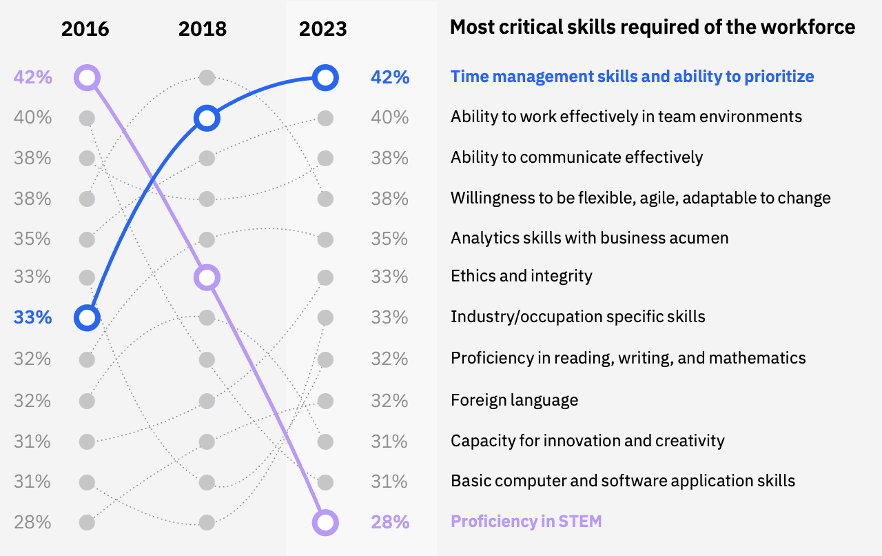
Infographic taken from IBM: Augmented work for an automated, AI-driven world
The Soft Skills Imperative
Recent research by IBM, involving 3,000 leaders and 21,000 workers across 20+ countries, has shed light on the increasing demand for soft skills beyond technical expertise. These skills include time management, collaboration, and communication.
Here’s how HR professionals can take action:
1. Time Management Mastery
Offer time management workshops or seminars for employees, providing practical tips and tools to enhance their time management skills. Create a resource library with time management resources for ongoing development.
2. Cultivating Collaboration
Implement cross-functional team projects that require collaboration. Encourage team members to share their experiences and best practices in collaborative settings. Create a collaborative workspace to foster teamwork.
3. Effective Communication
Offer communication training programs emphasizing active listening, clear speaking, and conflict resolution. Foster frequent team meetings to enhance departmental communication.
ThinkAdapt Business Simulation
A Unified Solution: ThinkAdapt by ThinkCodex
To bridge the gap between recognising the importance of soft skills and effectively fostering them within your organisation, we introduce ThinkAdapt by ThinkCodex.
ThinkAdapt functions as both a teambuilding simulation and crisis management theories. Teams engage in an adrenaline-charged environment, where they:
Master Time Management
Prioritise Collaboration
Emphasise Communication
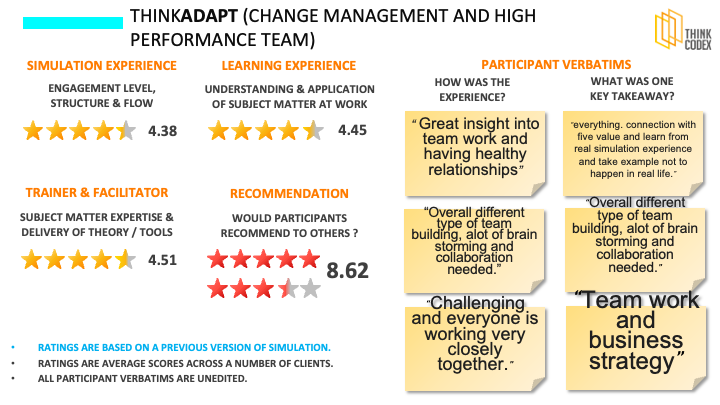
By deploying ThinkAdapt, HR professionals can reinforce the soft skills development journey within their organisations. It’s a real-world solution that mirrors the challenges businesses face today.
We’ve successfully partnered with esteemed clients such as Nestle, AIA, and Sumitomo-Mitsui Banking Corporation, witnessing firsthand how ThinkAdapt equips professionals with the essential skills needed to thrive in the ever-evolving professional landscape.
Testimonials from our learners
As we head towards 2024, HR professionals need to focus on developing soft skills such as time management, collaboration, and communication. ThinkAdapt simulation by Think Codex can help prepare your team for the challenges of tomorrow!
We live in an age of corporate training that often feels more like a chore than a transformative experience. Slide after slide of uninspiring content and endless multiple-choice quizzes. But what if learning at work could be… engaging & fun?
That’s the exciting question that’s gaining momentum. We’re not merely talking about gamification; we’re talking about gamified training done right. Join us as we explore a groundbreaking study conducted at KPMG by Harvard Business Review, a prominent player in professional services.
Example of employees playing games at workplace
The study at KPMG assessed the impact of gamified training on employee performance, specifically examining the “KPMG Globerunner” program. This training incorporated gamification elements, immediate feedback, and competition, and was implemented across 24 offices over 29 months. The study found that gamified training had a significant positive impact, resulting in increased fees collected, a larger client base, and more business opportunities. It also highlighted the pivotal role of leaders in this training approach and offered recommendations for organizations looking to implement similar training programs.
Key Takeaway 1: Gamified Training Supercharges Employee Performance
When gamified training is executed thoughtfully, it has the power to significantly enhance employee performance. The winning recipe includes well-structured lessons with elements such as progressing through challenges, real-time feedback, earning points, and a touch of friendly competition.
The results speak for themselves: a remarkable increase of over 25% in fees collected, a 16% growth in clients served, and promising new opportunities on the horizon. It’s more than just a game; it’s about making substantial improvements in how employees carry out their roles.
Key Takeaway 2: The Impact of Engaged Leadership
Now, let’s turn our focus to leadership. The study at KPMG emphasizes the crucial role that leaders play in this training approach. When leaders actively participate, the results get even better.
Offices whose leaders participated more than others increased fees collected by 19% more and grew the number of clients served by 7% more. Leadership involvement sets the tone for the entire team.
Key Takeaway 3: Cultivating a Culture of Enthusiasm and Play
Creating a work environment where playing is not just allowed but encouraged can be transformative. When leaders themselves embrace the training as an integral part of work, it sends a powerful message to the entire team.
ThinkAgility: Leadership Simulation for British American Tobacco (BAT)
Problem Statement:
Across the global landscape, British American Tobacco (BAT) faced challenges within its leadership & core teams to be agile with the ever-changing business environment – especially with a shift in consumer behaviour and regulatory compliance. Collaborating effectively and being able to respond to market changes was good in some teams but less so in other teams. There was a pressing need for an improved and structured way to make informed decisions and deliver results.
Our Solution:
Introducing ThinkAgility, aimed at delivering agile results within BAT’s leadership across diverse locations, including Australia, New Zealand, Oceania, and various Asian countries in partnership with Brandt International. Through a combination of business simulation-based workshops and debrief sessions, ThinkAgility helps participants understand, retain, and apply their learnings effectively in their work.
The game aspect:
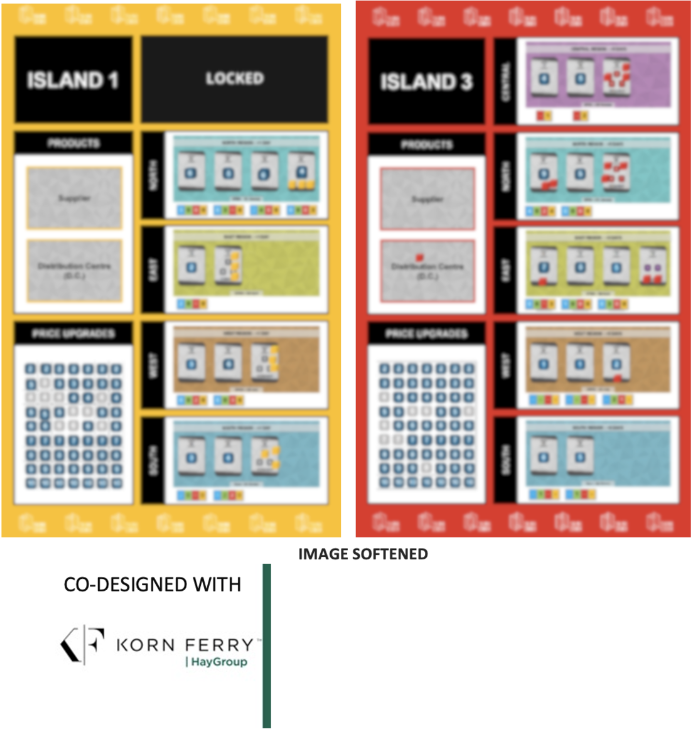
Participants, taking on roles as strategists, auditors, client liaisons, and region managers, embarked on a transformative journey. They were entrusted with overseeing various regions in a dynamic simulation.
Simulation Objectives:
Managing complex team dynamics and limited resources.
Understanding team members’ strengths and limitations.
Developing flexibility and agility in the face of competition and unexpected scenarios.
Delivering results the first time in tough circumstances.
Before each round, they engaged in thought-provoking discussions on strategy and resource allocation. This strategic element is key in the fast-paced, ever-changing business landscape.
Learning Outcomes:
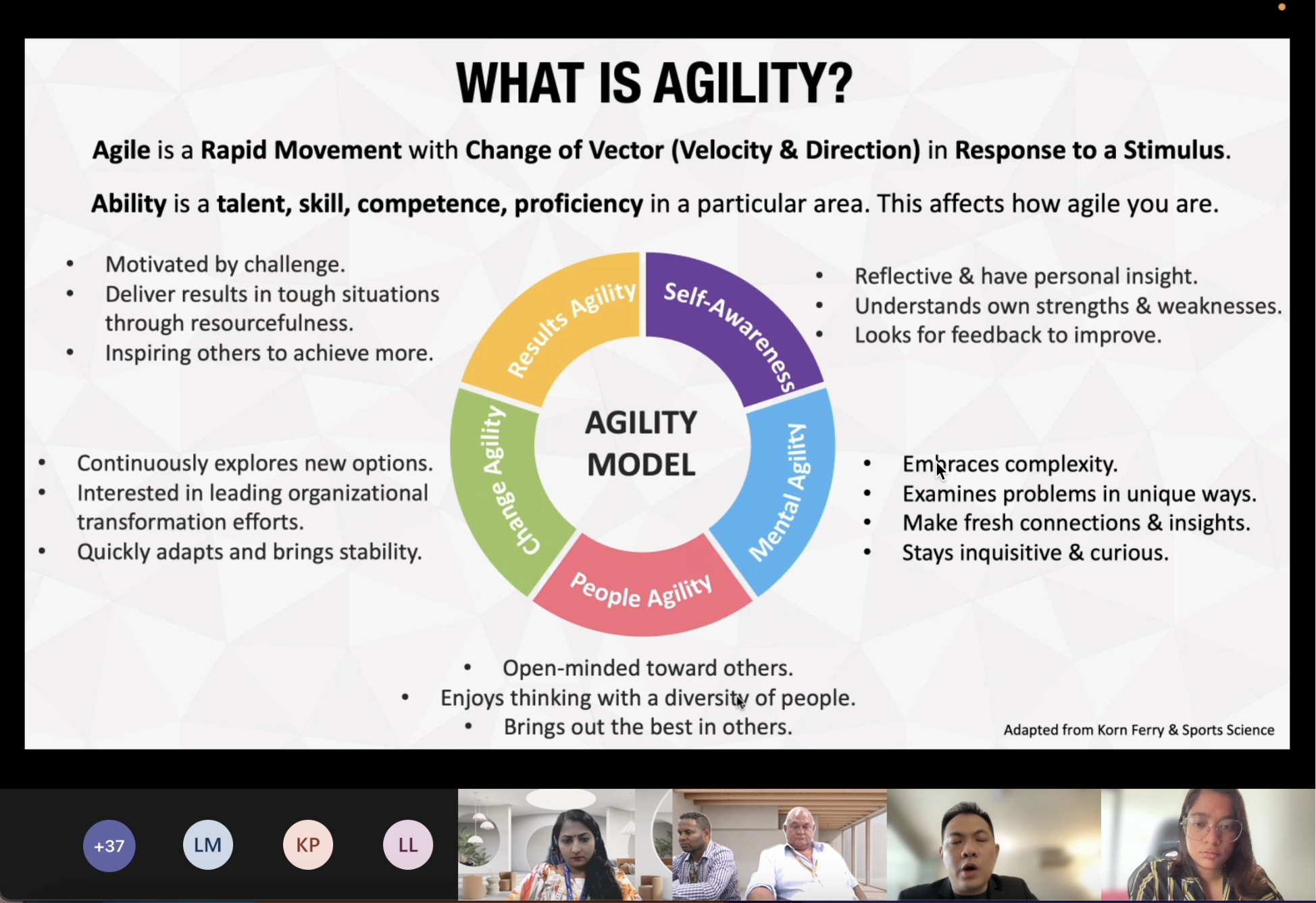
Results Agility: Navigating challenging situations to deliver results.
Change Agility: Comfortably adapting to change and experimenting.
People Agility: Effective communication and collaboration across diverse groups.
Mental Agility: Solving problems in unique and innovative ways.
Self-awareness: Recognizing one’s strengths and weaknesses.
Debrief on agility concept during the virtual training session
Throughout the simulation, participants encountered deliberately crafted scenarios meant to disrupt their team’s strategies, compelling them to adapt in real-time. It was more than just a game; it was a profound lesson in learning agility.
So, did it help them?
The transformation experienced by our participants was profound. They discovered a newfound agility in their approach to tasks and projects.
Here are some key insights they shared:
“Being agile in my approach to tasks and projects. Identifying tasks that can be executed simultaneously without dependencies. Leveraging the strengths of my team members. Remaining vigilant and ready to adapt in any situation to meet objectives without compromise.”
“Balancing the strengths of my team with the tasks at hand. Striking a harmonious equilibrium between consistency and flexibility to achieve outstanding results.”
“I wished that I had gone through this engagement earlier – my team would have been better equipped with managing the challenges during the rollout and pivoting of our market strategies”
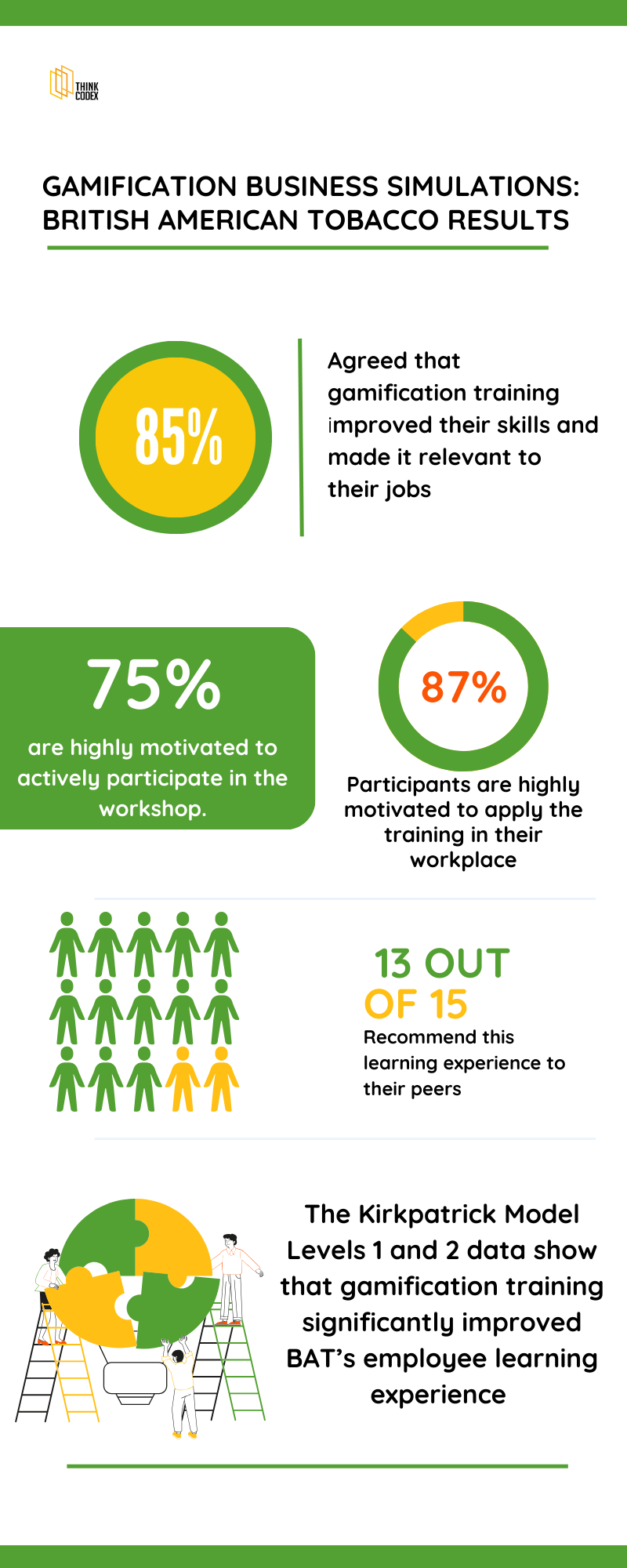
The consensus is clear: this training not only motivates active participation but also encourages the practical application of learning in the workplace. It’s more than a shift in mindset; it’s a driving force for continuous improvement on the job.
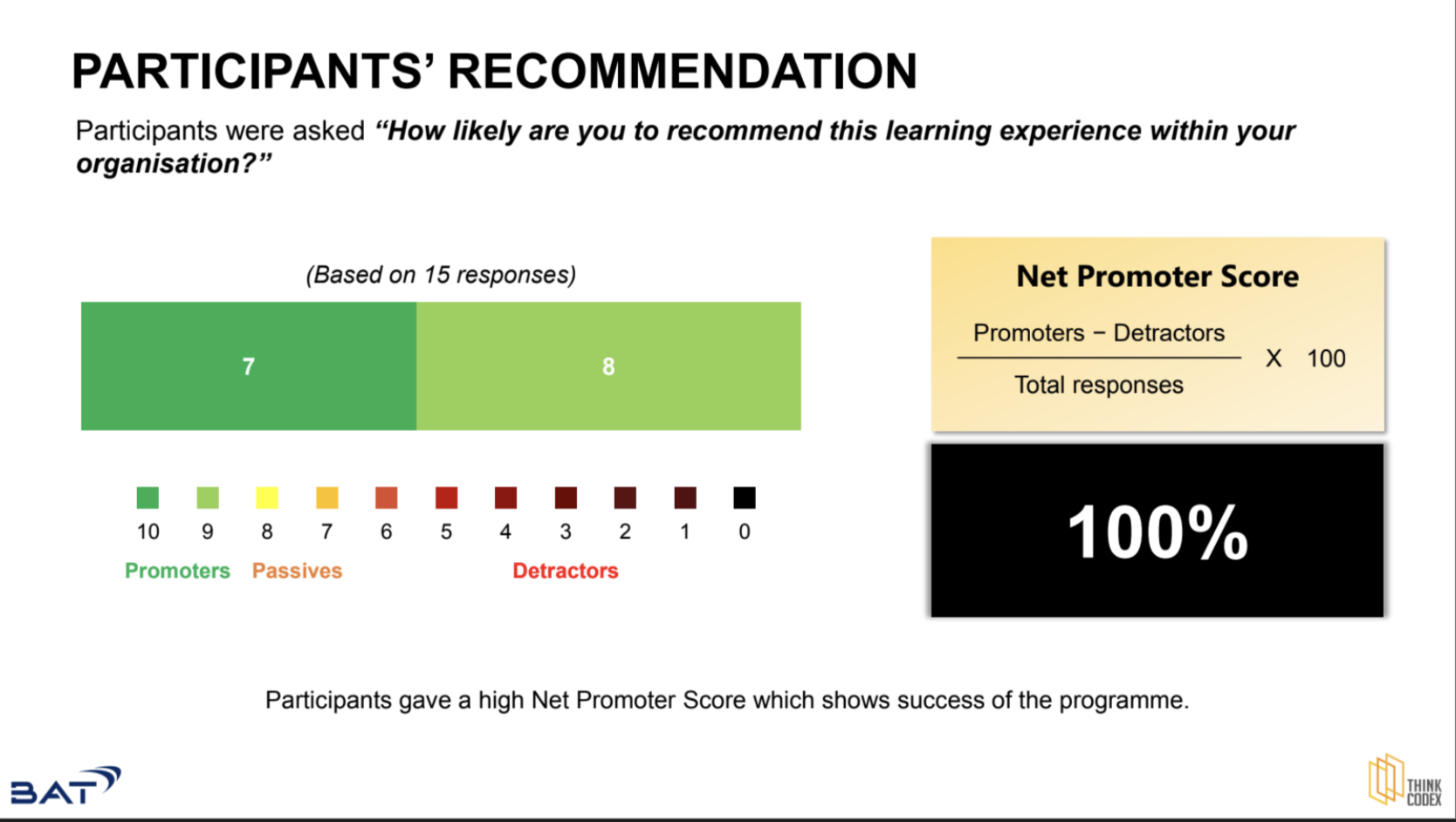
NPS on participant’s recommendation
In essence, our collaboration with BAT in gamified training harmonizes with the insights from the Harvard Business Review. It underscores the significance of leader engagement, the creation of a learning-friendly atmosphere, and the measurement of outcomes at an organizational level.
This isn’t just about education; it’s about inspiring change and nurturing newfound agility when addressing work-related challenges. As one participant aptly put it, “This training got me thinking about my current role and how to enhance productivity with my team and across the business. It’s about implementing change and ensuring consistency along the way.”
We firmly believe in this transformation, and we’re excited to continue leading the way in innovative corporate training. It’s not just a game; it’s a game-changer!
*ThinkCodex is a 4-time Gold Winner for the Best Team Building Vendor as voted by HR directors of Fortune 500 organizations & MNCs. We’ll be sharing our insights and also use a case study to demonstrate what a best-in-class team-building programme looks like.
Unlocking the Future of Team Building: Beyond Just Fun
Is team building just a fun event without real potential for change? In today’s ever-evolving landscape of employee engagement, it’s time to rethink the possibilities.
Imagine a world where your team-building activities not only foster camaraderie but also elevate your employees’ skills and align them with your company’s values. This is the future of team building, and it’s closer than you might think.
The Problem With TEAM-BUILDING Programmes
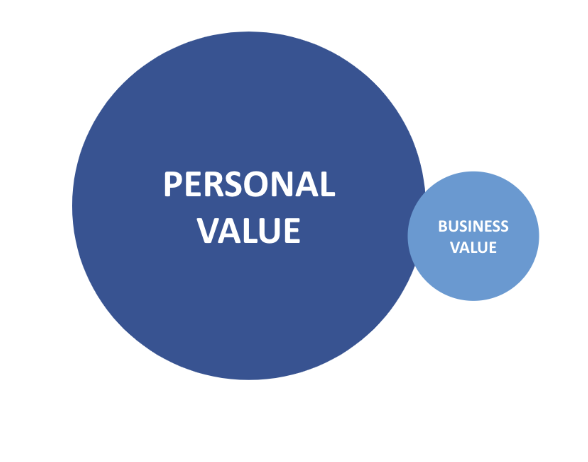
When discussing team-building strategies, it’s vital to keep in mind the two primary stakeholders: The Business and The Employee.The Business provides funding for these events, while The Employee actively participates in them. Although team-building events are often designed for personal enjoyment, it’s crucial to understand that this is only one aspect of the overall process.
Failing to closely align employees with the core values and mission of the organization could result in a significant disconnect that ultimately affects team dynamics and organizational success. Thus, it’s critical to prioritize BOTH personal enjoyment and the creation of a cohesive team environment that closely aligns with the goals and objectives of the organization. By doing so, businesses can foster a sense of unity and common purpose that genuinely benefits everyone involved.
Balancing Act: Business and Personal Value
At Think Codex, we believe in a balanced approach. We recognize the importance of both Business Value and Personal Value in team building. So, what does a great team-building event look like? It’s one that effectively combines these two aspects.
The Six Building Blocks of Great Team Building
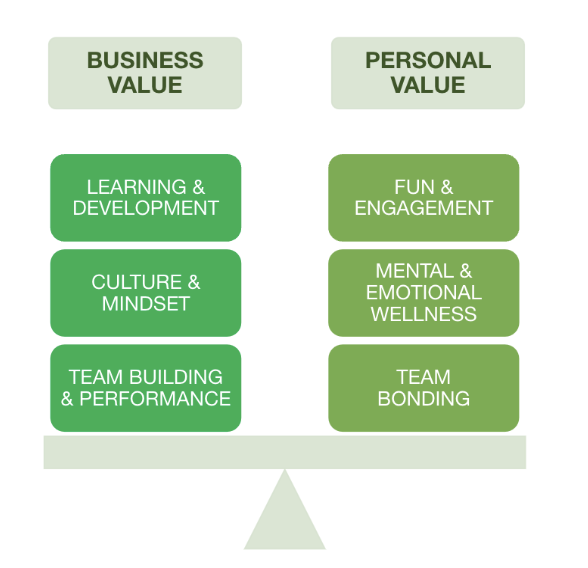
Six building blocks of great team building
A remarkable team-building event integrates at least four components from each side of the spectrum, Business Value and Personal Value. Let’s explore these building blocks:
Business Value:
Growth: Provide employees with opportunities to learn and develop skills applicable to their work.
Alignment: Foster awareness and connection to your company’s purpose and values through Culture & Mindset.
Team Upskilling: Equip employees with the principles of high-performance teams for practical application.
Personal Value:
Experience: Ensure enjoyment and relaxation, offering a break from work-related stress.
De-stressing: Allow employees to release built-up negative energy through mental and emotional wellness practices.
Interaction: Encourage team bonding through enjoyable group activities.
Gamification: The Catalyst for Change
In the dynamic realm of employee engagement, traditional team-building methods often fall short. They can be too basic, offering little long-term value to participants or the organization. Employees today seek more than just fun; they crave opportunities for growth and development. Entergamification, a game-changing solution that addresses these challenges head-on.
Gamification in team building is not merely a trend; it’s a necessity. It’s the bridge between enjoyment and growth. Gamification transforms your team-building events into powerful tools for skill development and values alignment.
What A Great TEAM-BUILDING Programme Looks Like
A great team-building programme must have these 4 components:
Increased Employee Engagement: It must be engaging and immersive, going beyond just having fun and fostering a sense of purpose and achievement.
Skill Development: It’s a learning opportunity. Your team will acquire practical skills that can be applied immediately in the workplace, effectively closing skill gaps.
Values Alignment: It facilitates a deep understanding of your company’s values and purpose. Your team will not only know these values but also embody them.
A Bit of Pressure: It adds a bit of a challenge so that teams can have a deeper-level building as opposed to surface-level bonding. According to Flow Theory, people grow best when tasks are not impossible and not too easy. This applies to teams as well.
Case Study: AIA and ThinkBuild ESG Simulation
AIA, a prominent player in the insurance industry, recognized the need to build high-performing teams and deepen their commitment to Environmental, Social, and Governance (ESG) principles. That’s when Think Codex entered the picture with a game-changing solution.
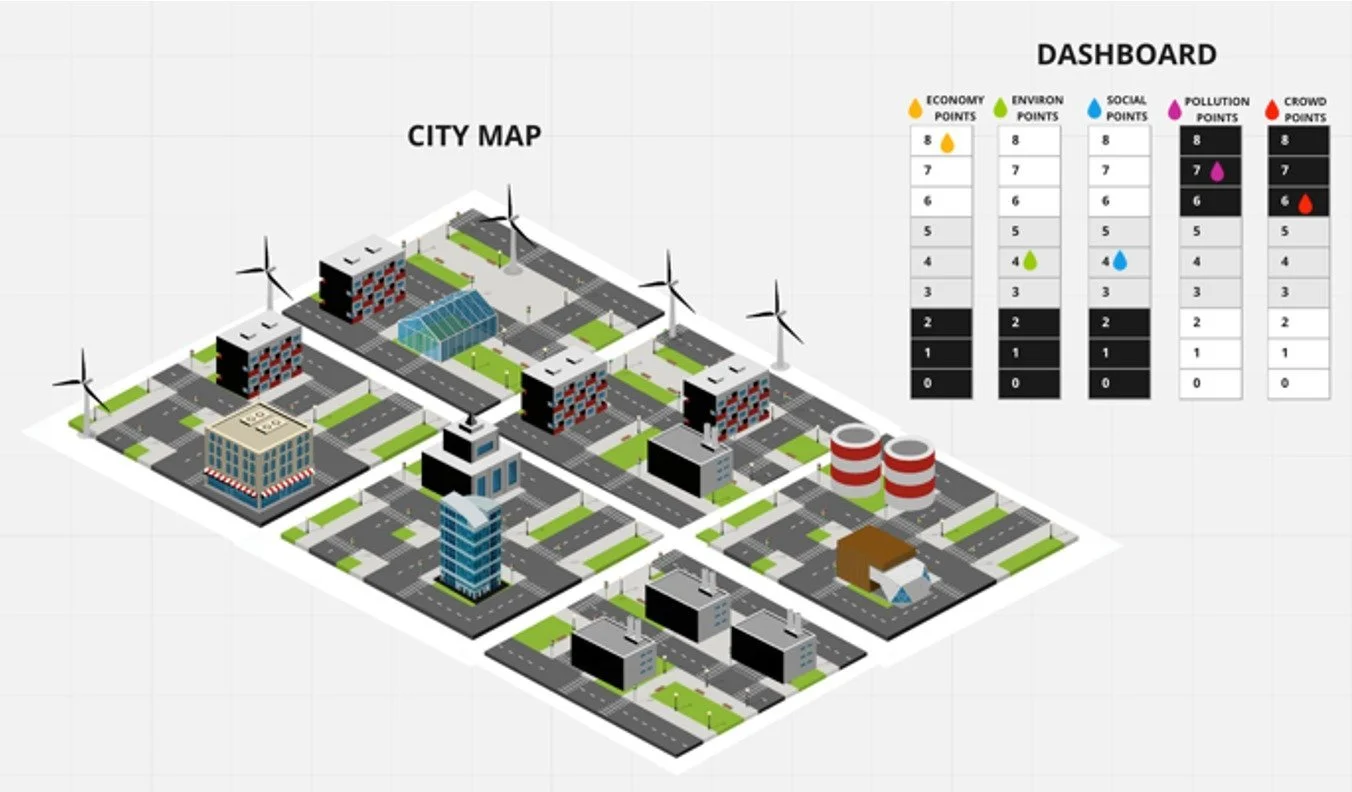
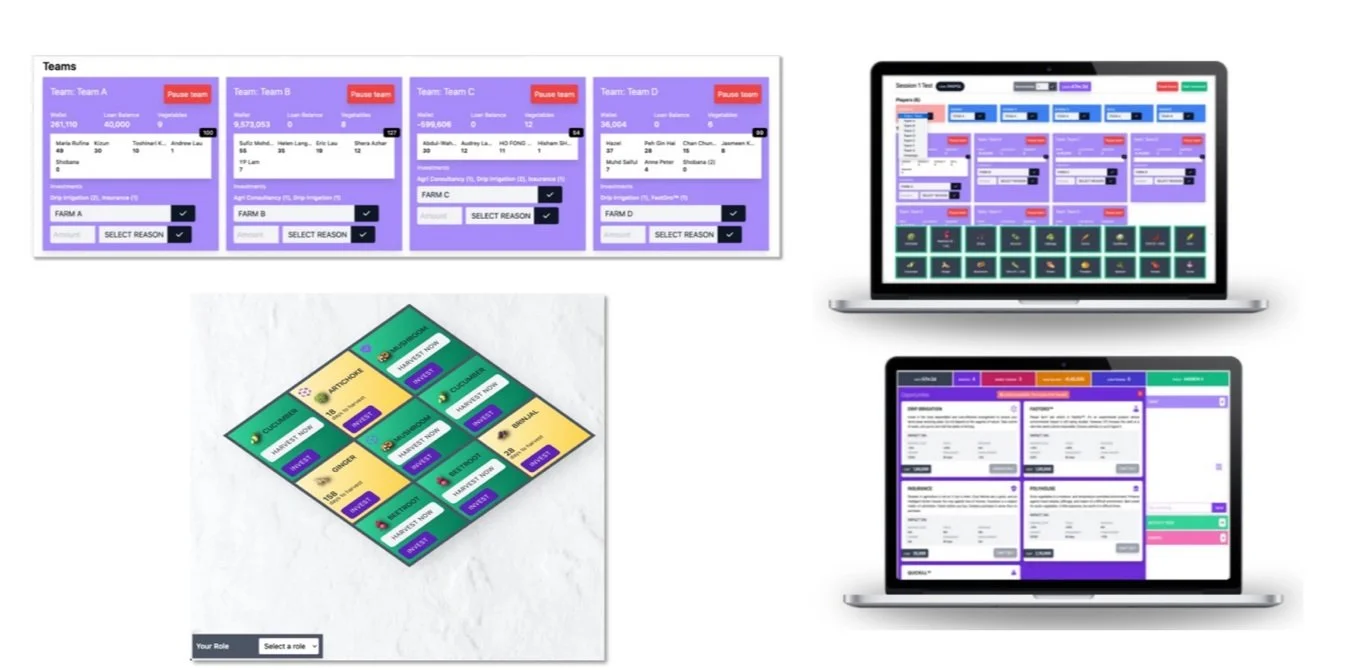
Here is an example of a digital version of the ThinkBuild simulation
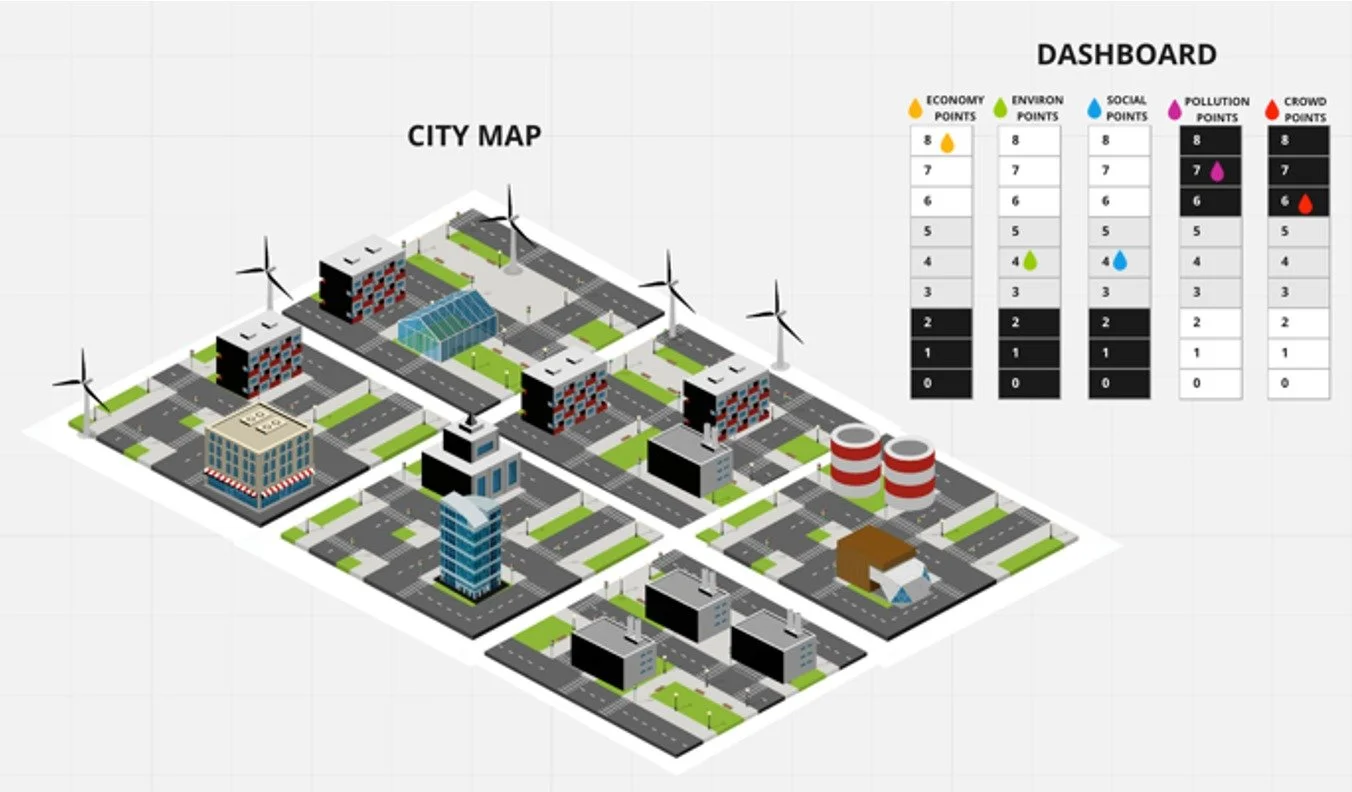
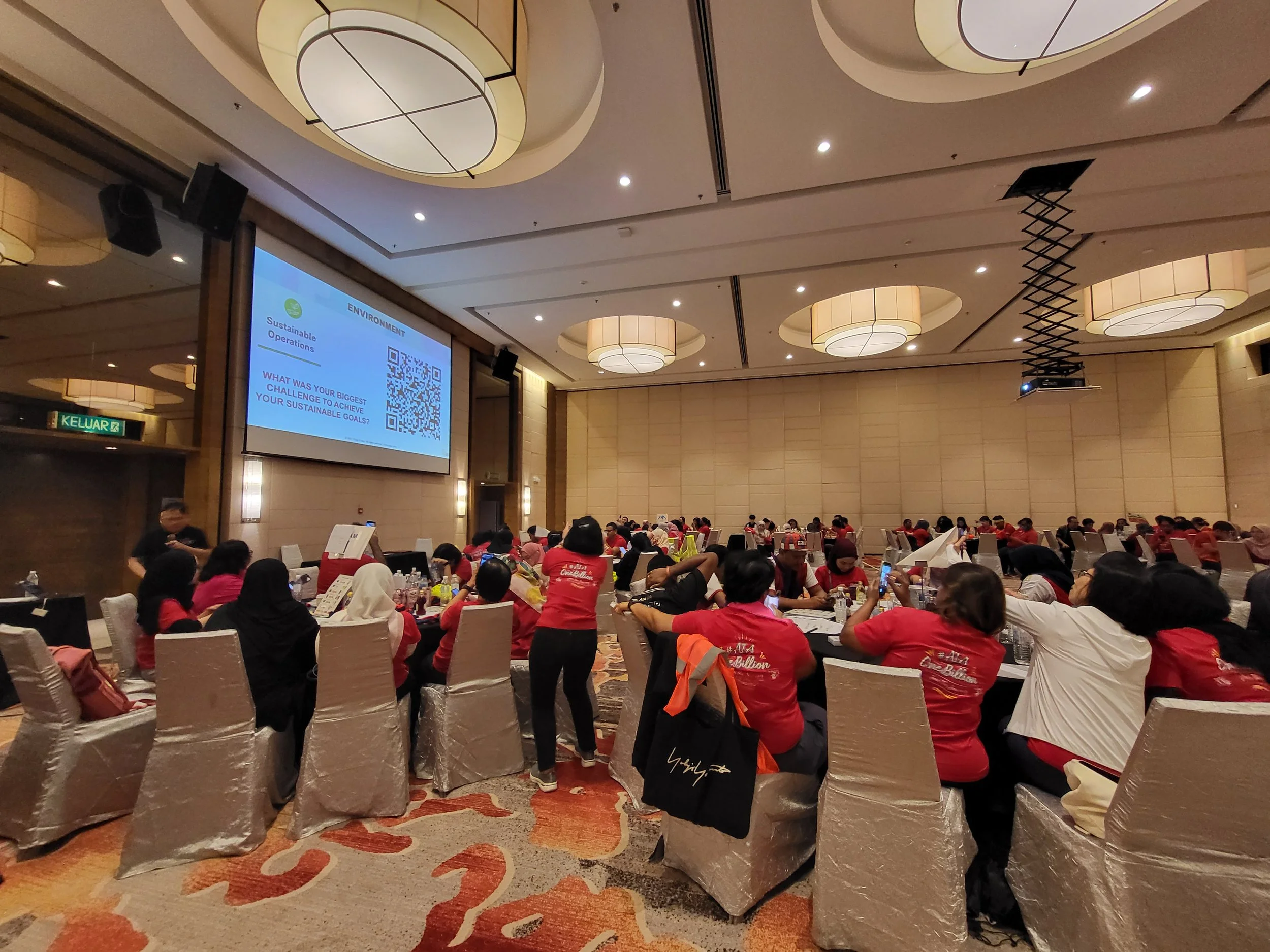
The implementation of a hybrid simulation modelESG Focus Principles for AIAs
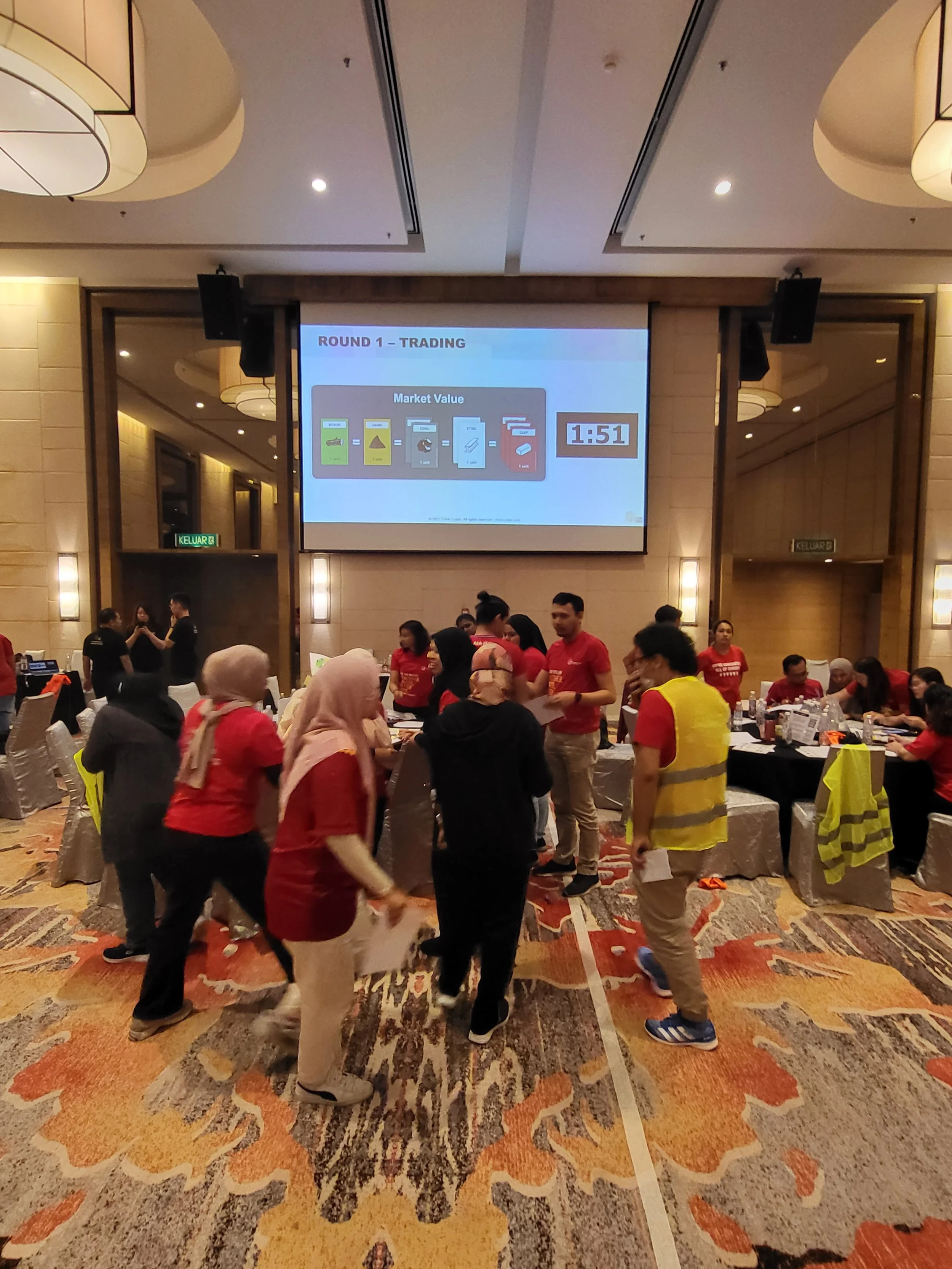
Introducing ThinkBuild Simulation, an interactive team-building experience that incorporates ESG education. This simulation lasts for over an hour and allows participants to delve into the essence of teamwork while tackling sustainability challenges. Teams work together to construct sustainable cities through planning, building, and reviewing. Although it’s not as intense as our main simulation, it effectively promotes team cohesion and is a fun experience. What makes ThinkBuild Simulation unique is its seamless integration of virtual simulations and in-person interaction. With this innovative approach, all 103 participants can fully immerse themselves in the interactive experience and enjoy the benefits of collaborating face-to-face.
During the ThinkBuild Simulation, participants gain valuable insights and key learnings:
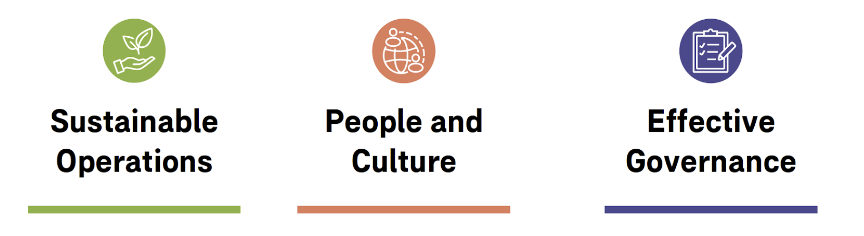
Understanding Team Stages: Participants can experience and understand the different stages of team development, leading to a deeper appreciation for team dynamics and alignment with Sustainable Operations’ ESG principles.
Building and Sustaining Culture: Through sustainable city planning, teams learn how to build and sustain a culture and identity within a team, an invaluable skill applicable to their real-life work environments, where they can better understand the role of People and Culture.
Problem Solving and Growth: Through ideation, problem-solving, and growing as a cohesive unit, participants gain problem-solving skills that can be effectively applied in their professional lives. This aligns with Effective Governance as part of their ESG principles.
This holistic approach not only enhances team performance but also instils a sense of purpose and achievement in participants, making it a transformative experience that extends beyond the simulation itself.
ESG-Focused Simulations: Bridging Theory and Practice
Participants face scenarios and challenges that demand the application of ESG practices for success. This hands-on approach not only educates but also encourages critical thinking about applying ESG principles to their roles. They learn how sustainable practices can positively impact their work, their team, and the environment.
In a world where change is the only constant, the ability to adapt and improve is crucial. Gamification, with its built-in feedback mechanisms, ensures teams don’t just participate but progress. It’s a win-win for businesses and employees, making team building more effective and enjoyable than ever before. This collaborative element enhances not only team dynamics but also deepens their understanding of ESG principles through shared insights.
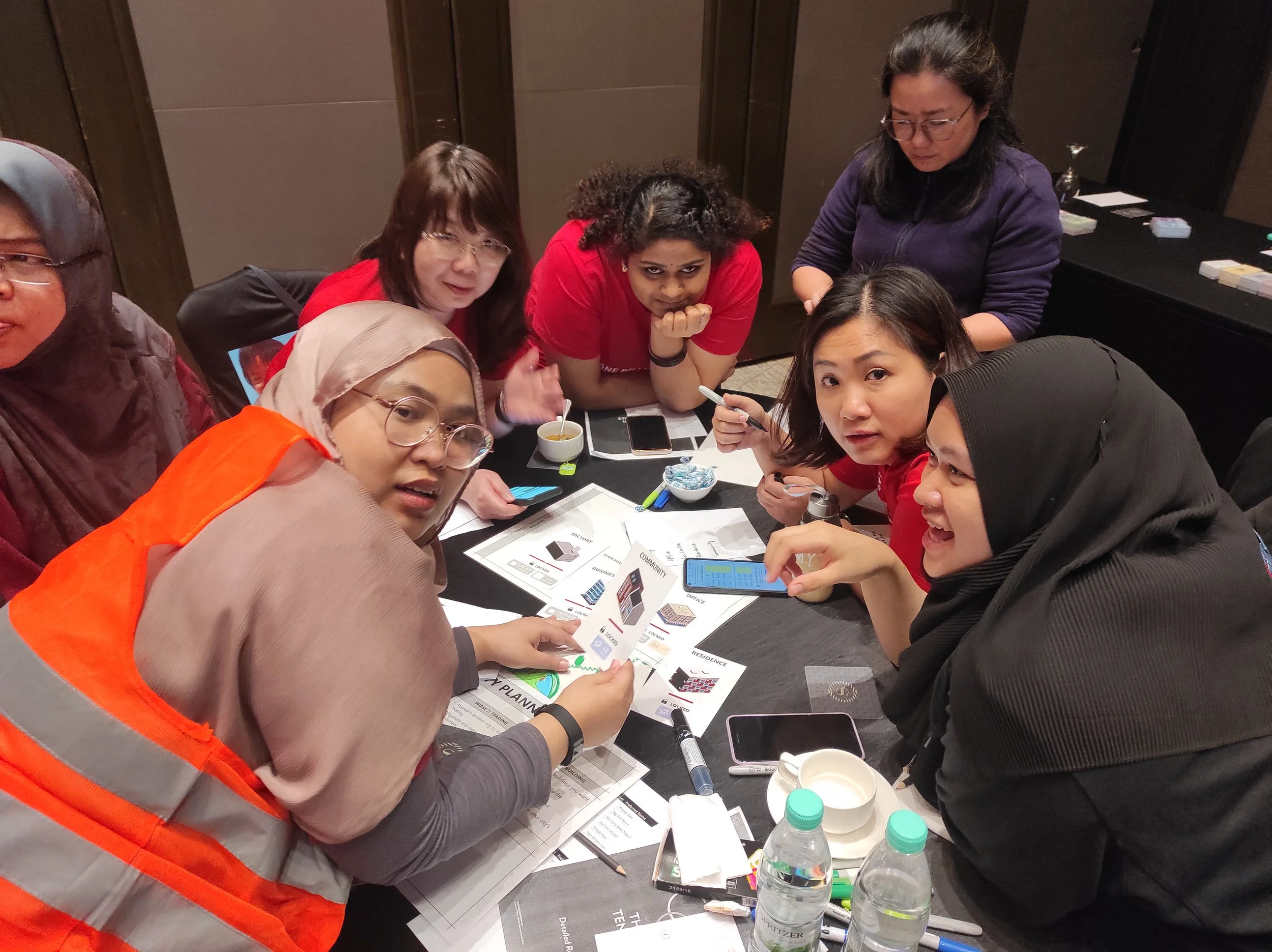
Physical ThinkBuild simulation example
Measuring Success: The Kirkpatrick Evaluation Model
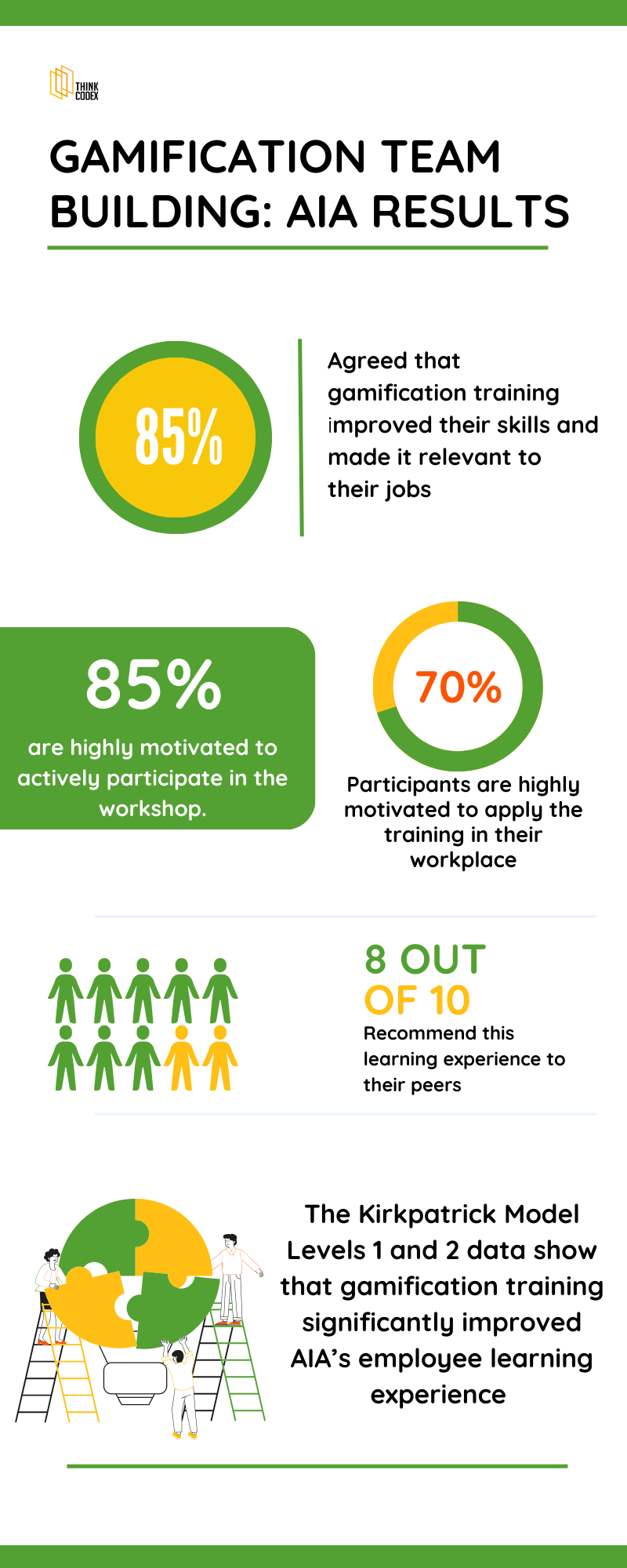
To gauge the impact of the ThinkBuild Simulation, we employ the Kirkpatrick Evaluation Model, focusing on Level 1 & 2 evaluation, which assesses participants’ experience and also learning.
The infographic presents a comprehensive overview of the results attained
The Results Speak Volumes
AIA employees rated the ThinkBuild Simulation highly, with an impressive overall rating of 8 out of 10. This isn’t just a number; it’s a testament to the effectiveness of gamification in team building and ESG education.
Here’s what some participants had to say:
“Hands-on experience that tackles real-life challenges.”
“Engaging trainers who make learning enjoyable.”
“Not your typical training; the skills gained apply both at work and in daily life.”
Elevate Your Team Building with Gamification
Want to improve your team-building skills? Look no further than gamification. With its feedback mechanisms, gamification ensures that teams not only participate but also progress. This can lead to increased effectiveness and enjoyment for both businesses and employees.
Think Codex and AIA have collaborated to create an example of how gamification can be used to elevate team-building, foster ESG insights, and drive success in organizations across industries. By unlocking the full potential of your teams, you can empower them with the knowledge and skills needed to succeed in today’s business landscape.
If you’re interested in exploring different ways that team-building gamification simulations can help you achieve your organizational goals, speak to our CONSULTANT for FREE demo session today.
Every Learning and Development (L&D) team’s dream is to have committed and competent employees, the vehicle that drives an organization’s growth and profit in an ever-growing business landscape. It falls to the L&D teams in organizations, small and large, to develop and retain talents with the appropriate skills and attitude, yet this challenge has only increased following the pandemic. With the changes in employee expectations, more so with Generation Z entering the workforce, it is far too easy for managers to take on a reactive mindset and prematurely conclude that employee attitude or work ethic has deteriorated.
As part of the L&D community, we are responsible for aligning employee career goals with company goals, so we must take a proactive mindset in understanding what underlies this phenomenon, and one such approach is through employee feedback.
Co-workers engaging in discussion
This article will first propose 4 ways an organisation’s L&D could benefit from listening to and acting on employee feedback. Next, we explain how employee feedback is inherently tied to the most essential elements of human motivation, which then predicts employee performance and retention.
WHAT ARE THE 4 WAYS?
Employee feedback gives you a clear picture of the skills or support that is currently missing in the team and, consequently, what type of support or training the team needs. With the increasing complexity of the technology and problems to solve, the plethora of platforms or business tools make it challenging for L&D to accurately identify the most relevant and appropriate for their company within budget and time constraints. Prior to adopting any new tool or introducing any new training programme, L&D needs to have a clear and accurate understanding of the challenges or roadblocks currently faced by employees. As such, employee feedback would highlight said issues, allowing the L&D team to accurately identify the relevant skills required by the employees. For example, employees could be stagnant in their careers and might benefit from a more structured way of brainstorming or strategic planning, but if you manage to identify that the employees already have excellent ideas, it is possible that their struggle lies with communicating their ideas in a clear and convincing manner. Since the L&D’s role is to ensure that employees are equipped to achieve the results that are expected of their position, employee feedback could shed light on the optimal way to use the company’s resources to grow the team.
1 to 1 feedback with your manager often helps
2. Furthermore, use employee feedback to ensure that the organizational and departmentalpolicies remain effective and efficient in the current times. As organizations grow in reputation and teams grow in confidence and expertise, the tendency to become more homogeneous and rigid increases. This means that people are more susceptible to groupthink and struggle with divergent thinking, an important aspect of creative problem-solving and critical thinking. Moreover, sometimes our standard procedures or best practices might no longer be effective or efficient. Employee feedback would then be an important data-gathering process in obtaining diverse, and even dissenting, opinions. Clarity on what still works and what requires improvement shields the team from groupthink and prepares the company for future challenges before they occur.
3. Additionally, it will ensure that the policies and processes in the organization are employee-centric, that is, the company’s vision is aligned with employees’ day-to-day work. Employees are more engaged and productive when their work and how they are treated at work are consistent and aligned with the organization’s vision and mission. For example, it would be hard-pressed for employees to think innovate and problem-solve in a culture that rewards rigid adherence to potentially outdated best practices. Rules and systems were created by people with specific purposes. Employees, the very people whom the vision and mission are meant to guide, would give you the most accurate feedback on whether the systems in place are achieving the purpose they are supposed to.
4. A subtle, and less direct, effect of active listening and acting on employee feedback is forming a culture of learning. As L&D, we act as models and examples to employees in terms of how to behave and act at work. By demonstrating that we are open to upward feedback and constructive criticism, we establish a safe environment for sharing ideas and experiences, an environment that emphasizes self-improvement and encourages humility, creating a space to have difficult conversations. A learning culture encourages employees to be transparent about their mistakes or struggles, which are important predictors of eliminating mistakes in the future. A learning culture promotes collaboration and learning from one’s peers and mentors, resulting in growth in productivity and innovation. Conversely, a culture that prioritizes performance undermines psychological safety, encouraging employees to be guarded and always on the lookout for their own performance and career. In conclusion, a culture that practices upward feedback values improving ourselves instead of proving ourselves.
Human Motivation
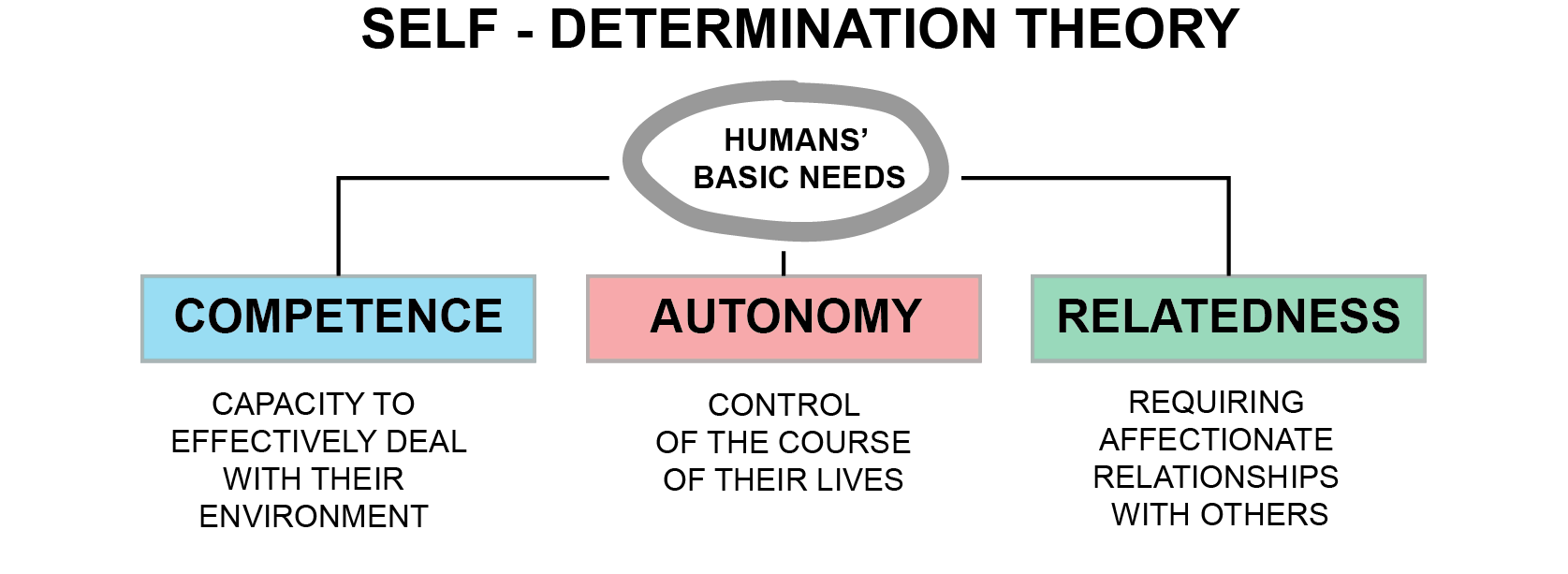
The aforementioned advantages of feedback in L&D touch on three important elements of human motivation. Based on the Self-Determination Theory, humans are highly motivated and demonstrate quality performance in an environment that encourages autonomy, foster relatedness, and grows their competence. By providing the most relevant support and training, we increase employees’ competency, allowing them to excel in their work career development. By designing employee-centric policies, we encourage employees to practice their autonomy as their feedback and engagement with the L&D could improve their work conditions and have an impact on the organization. Employees would then feel that they are part of the company as opposed to feeling like a replaceable cog in a machine, encouraging them to take ownership of their careers and increase their commitment.
Example of Self Determination Theory
CONCLUSION
It is easy to forget that employees are one of the stakeholders in the organization. What is an organization without the people or the processes (created by said people) in it? As with any other stakeholders, you need to understand their needs and involve them in decision-making processes. As such, employee feedback is vital in developing the ideal team in any organization.
Let us know what are your thoughts on this in the comment below and if you enjoy reading our articles, do join our community to get latest insights on gamification and L&D.
As companies invest more in Learning and Development (L&D) programs to help employees acquire new skills and stay competitive, measuring the success of these programs becomes increasingly important. In this article, we’ll explore different methodology models that L&D professionals can implement and the critical metrics they need to measure to demonstrate the value of their programs. We start off by examining the most widely used learning effectiveness model – Kirkpatrick Model and then comparing other models against it.
Kirkpatrick Model by Donald Kirkpatrick
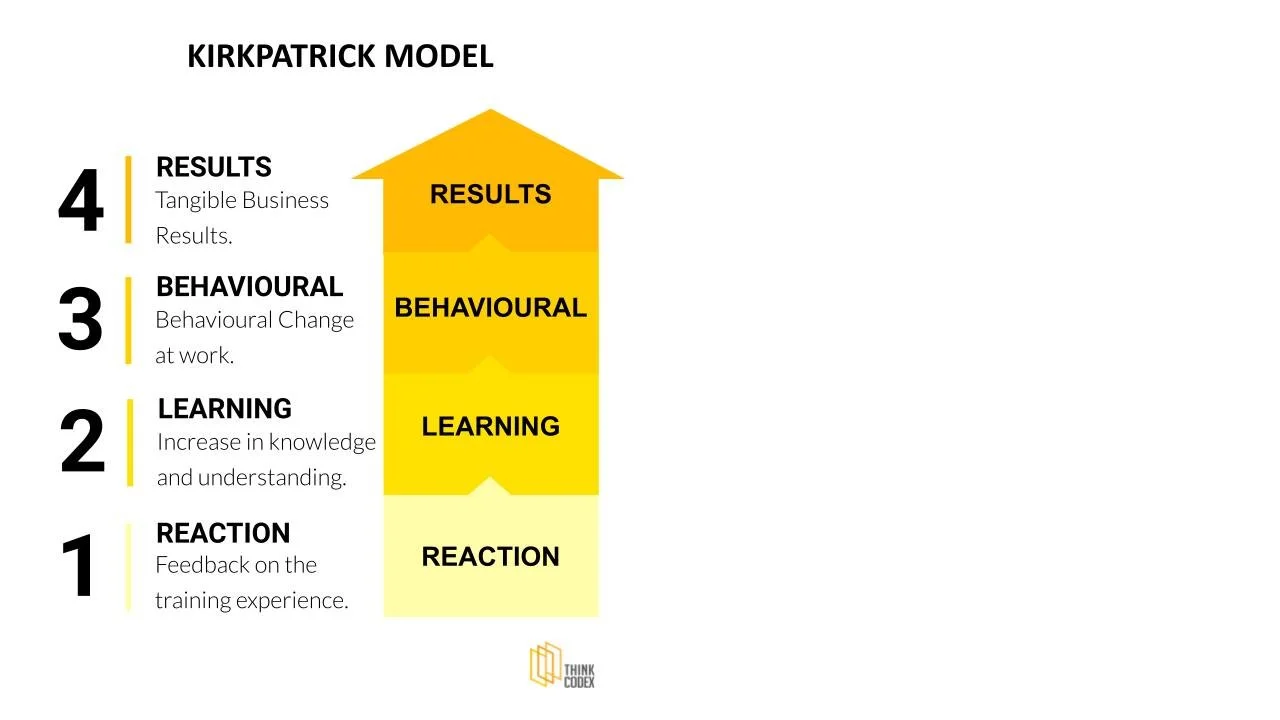
The Kirkpatrick Model is one of the most commonly used methodology models in L&D. Developed by Donald Kirkpatrick in the 1950s, this model has four levels of evaluation:
The Kirkpatrick Model is a valuable framework for evaluating the effectiveness of L&D programs. However, it’s important to note that the levels are hierarchical, and each level builds on the previous one. For example, learners are less likely to learn from the program if they don’t react positively to the program. They are less likely to change their behavior if they don’t learn from it. And if they don’t change their behavior, the program is less likely to positively impact the organization’s results.
Comparative Methodology Models
In addition to the Kirkpatrick Model, there are other methodology models that L&D professionals can implement to evaluate their programs:
Phillips Model by Jack Phillips
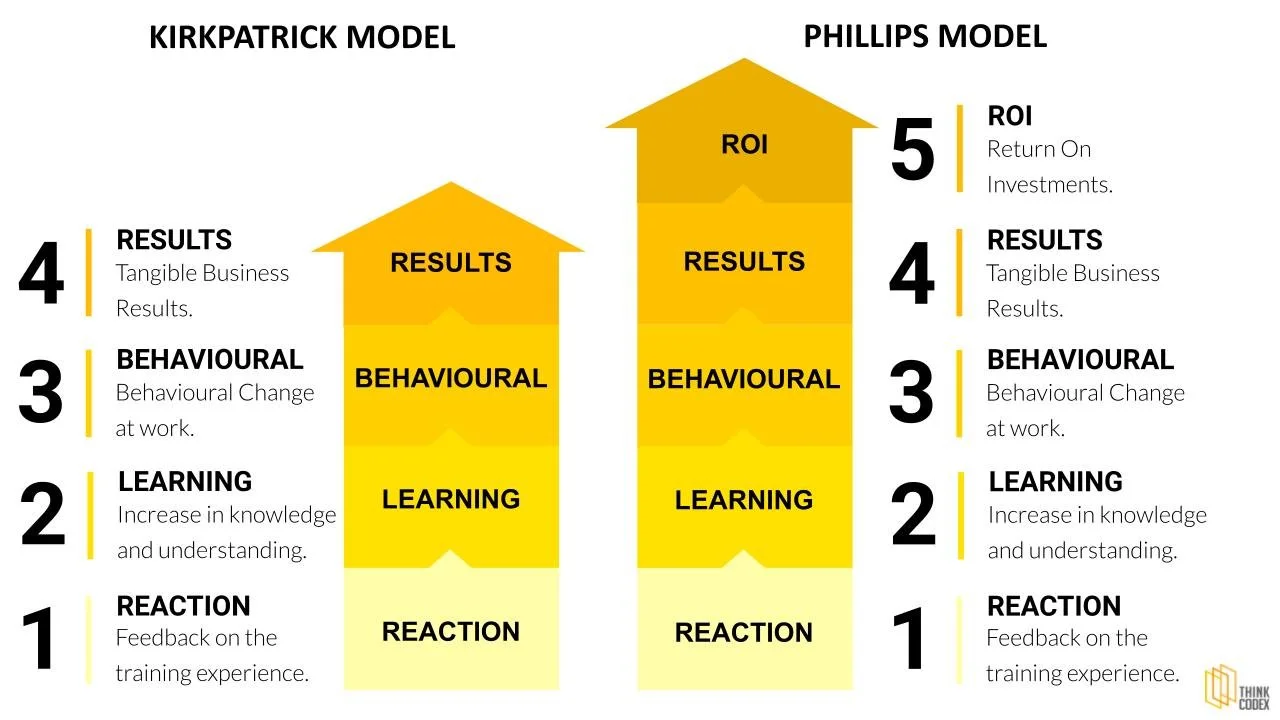
This model takes a step further by not just measuring Levels 1 to 4 which is similar to the Kirkpatrick Model but has a Level 5 measuring the return on investment (ROI) of the training program. The Level 5 ROI measurement uses data from L2 Learning, L3 Behaviour & L4 Results to create a model for finding out what monetary returns the organization is actually getting back from the training dollars spent.
L1 – L4: Following Kirkpatrick Model L5: Return on Investment
In the form of calculation,
ROI (%) =(Net benefits of the training program / Total program cost) x 100
In the end, the Level 5 calculation comes up with a percentage (%) of ROI. While this is something that is indeed good to measure, there remain a number of challenges in implementing Level 5. Among them:
1. High cost of effort to measure L5 – it takes extensive data collection and working with a number of stakeholders to get accurate data.
2. Delayed Results – as a lot of effort is required, the results of L5 can often be delayed beyond the expected timelines of evaluation by stakeholders.
3. Accuracy of measurement – while calculating, there are a number of assumptions made to put both tangible and intangible factors in focus. Some of these are subjective and up to interpretations depending on stakeholders. It’s important to note that this challenge appears in L4 of the Kirkpatrick & Phillips model to a lesser extent.
4. Ideal but not pragmatic – while it’s great to have these measurements, very few training programs warrant L5 measurements. Jack Phillips himself noted that only 5-10% of training programs require measurements at L5.
5. Lack of data or cooperation from the customer – sometimes a customer just does not have the data required to make a L5 measurement as not all companies track the data of their operations. In the absence of such data, it is often a painstaking process of creating new data sets which can require additional work for stakeholders – which leads to resistance from them.
Brinkerhoff Model by Robert Brinkerhoff
This model is also known as Brinkerhoff’s Success Case Model (SCM) which emphasizes the importance of post-training support and reinforcement to ensure that learners apply what they have learned. Brinkerhoff states that traditional evaluation models such as Kirkpatrick & Phillips models were wrong to just focus on assessing the scope of a training’s effect. He says that the true measure of business results is from performance. SCM is not concerned about finding the average performance of training participants (Kirkpatrick & Phillips Models), but focuses on looking for extreme examples on both ends of measurements.
As such this model measures the performance of the most successful participants and the least successful participants as use cases to understand how well did a learning program perform. The model looks at contrasts or extremes from both ends by seeking to understand 2 important areas:
In a best-case scenario, how well did a program perform? This is derived from analyzing participants who show the most increase in performance after a training program.
In a worst-case scenario, how badly did the program perform? This is derived from analyzing participants who may show the least or no increase in performance after a training program.
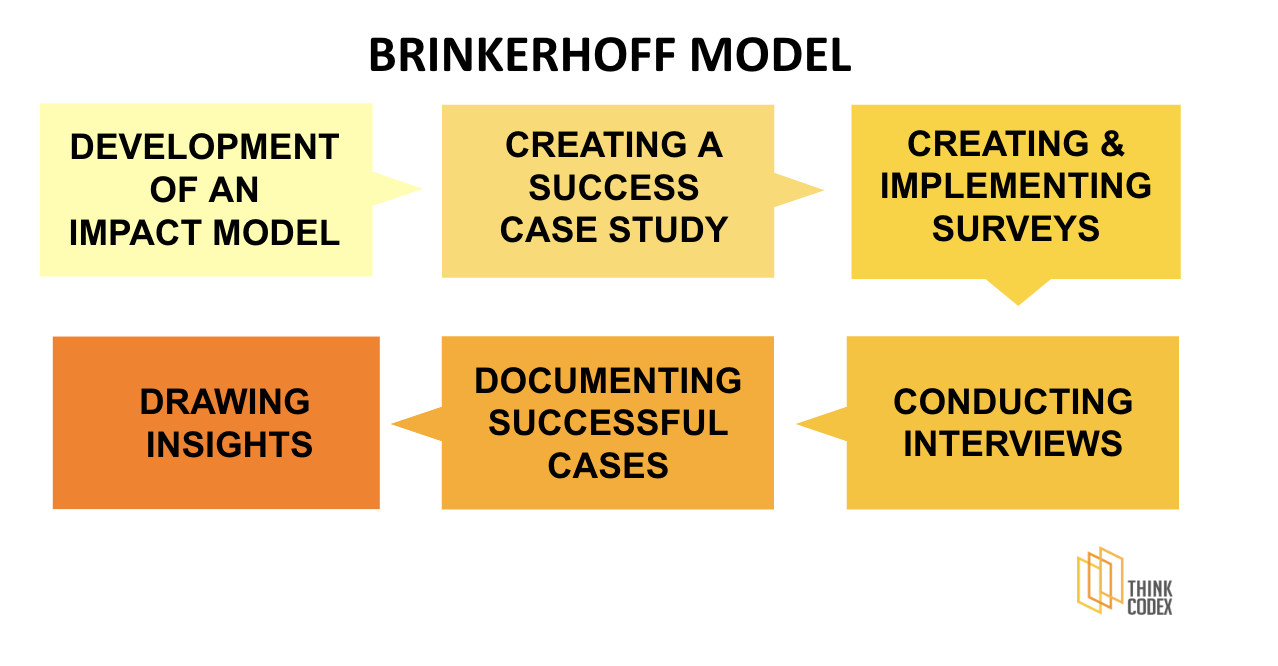
Brikenhorff Model
How this model differs from Kirkpatrick & Phillips models is that it requires a few things:
The development of an Impact Model – the definition of what success looks like.
Creating a Success Case Study.
Creating & implementing surveys that can identify best-case and worst-case scenarios.
Conducting interviews.
Documenting successful cases.
Drawing insights, summarizing conclusions, and providing recommendations to stakeholders.
Kaufman Model by Roger Kaufman
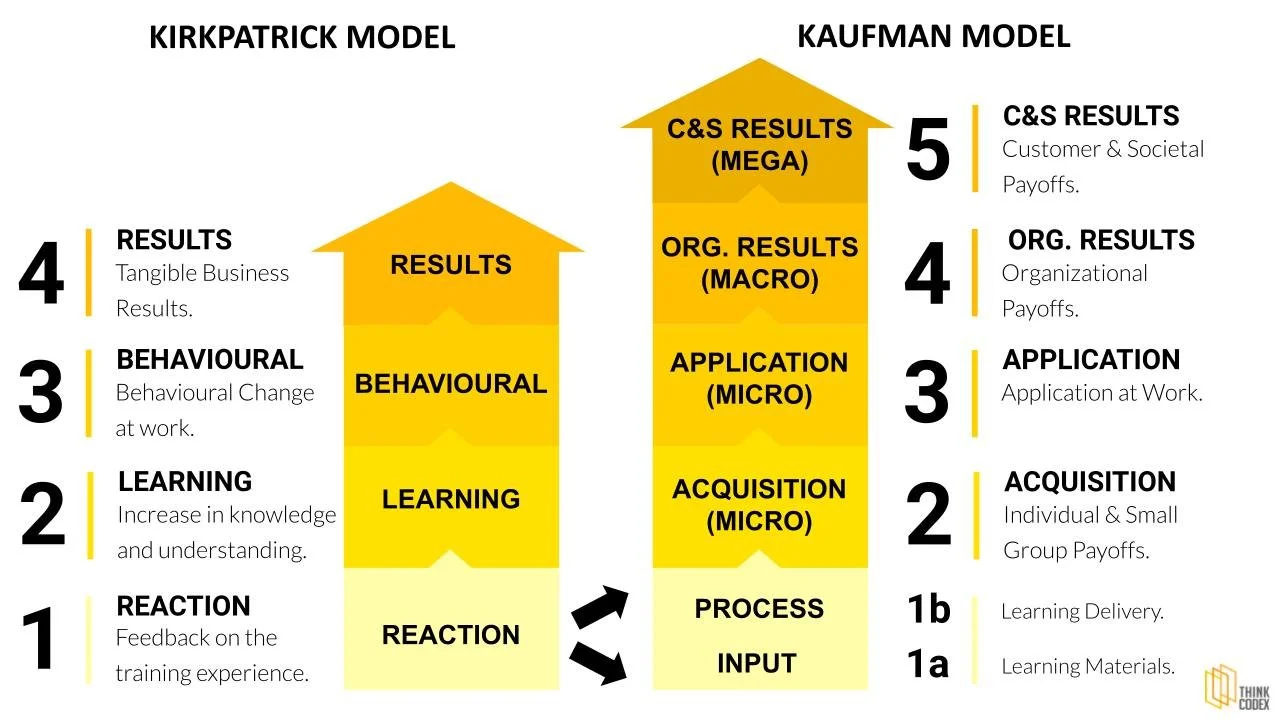
This model is based on Kirkpatrick’s model and seeks to improve on it by looking at measurements at a detailed level (L1a and L1b) and big picture level (L5). It’s broken into 5 levels – though if counted, there are actually 6 levels.
L1a Input: This level covers training materials.
L1b Process: This level covers the delivery of the learning process.
L2 Acquisition (Micro): Individual & small group payoffs. Did the learner “acquire” the learning?
L3 Application (Micro): How well the participants utilize what they have learned on the job.
L4 Organizational Results (Macro): Organizational level payoffs – business results.
L5 Customer / Societal Results (Mega): Customers & Society payoffs – the 2 major stakeholders that an organization serves.
Here are some key differences in the Kaufman Model:
1. Group ‘clients’ into Micro (Individual & Small Group), Macro (Organization), and Mega (Customers & Society). This is found in L2, L3, L4 & L5.
3. Introduces a new Level 5 (Customer & Societal Results) which looks at a much broader picture.
So what are the pros of the Kaufman model? Firstly the split in Kirkpatrick’s L1 (Reaction) breaks down the experience into 2 Kaufman factors – supporting materials (L1a Input) and delivery (L1b Process). This helps to isolate the issues of experience by looking at the quality of materials or the quality of delivery.
What are the cons of the Kaufman model? While aspirational and good from a high-level view, trying to measure customer & societal payoffs (L5) require extensive effort, time, and budget. There’s also a high level of ambiguity as there are too many factors at play when we talk especially about customer & societal impacts. In fact, by measuring at L5, it’s hard to isolate these impact factors. This goes against Kaufman’s original intent in where else the goal in L1a & L1b was to isolate factors.
So on one hand, the goal was to improve on Kirkpatrick’s model by isolation (L1a & L1b), L5 instead went against the same goal of isolation, thus giving conflicting views on the Kaufman Model.
Where does Gamification Fit Into all these Models?
Firstly, what is gamification? Gamification is the use of game phycology & game mechanics in non-game environments while achieving non-game outcomes. Such a use case is Learning & Development.
Coming back to learning evaluation models, at the core – most models measure 4 things:
Experience – What was the experience like?
Learning – What did the person learn?
Behaviour – Is there a change in behavior at work?
Results – What individual, team, or business outcomes can be seen?
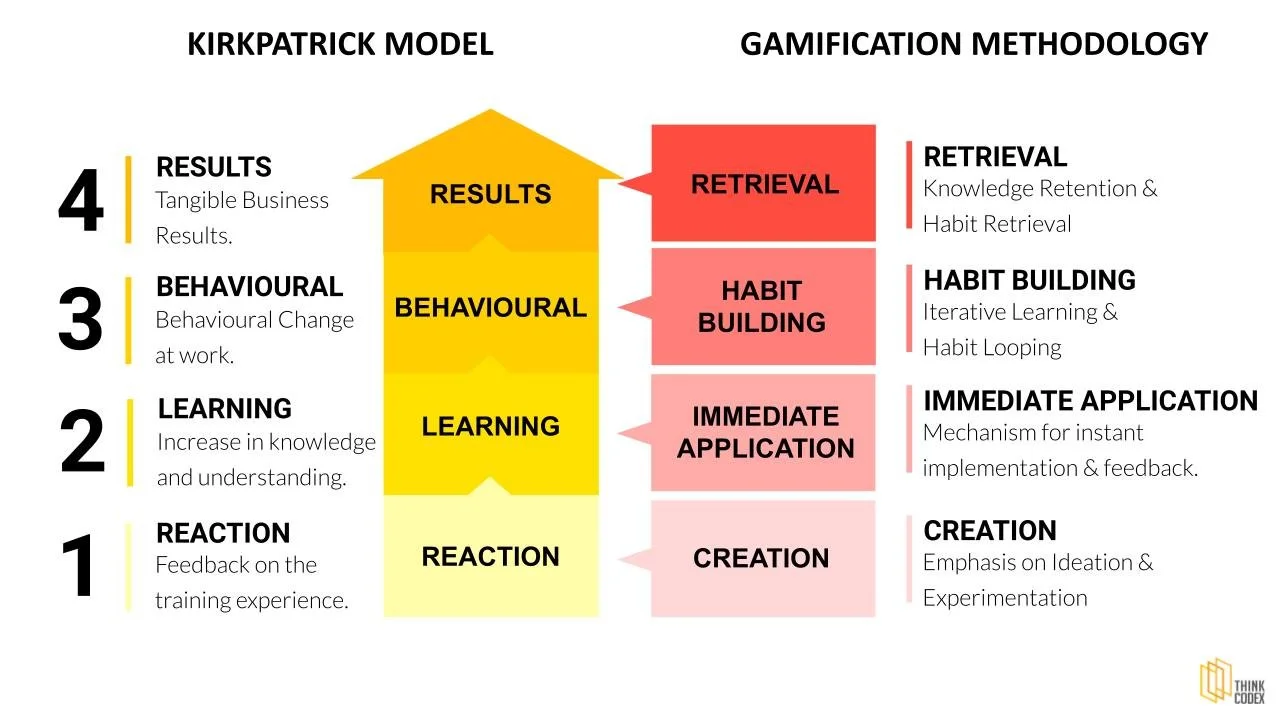
Gamification’s methodology itself is not an evaluation model but instead is considered one of the most effective ways to drive impact at the levels of Experience, Learning & Behaviour which ultimately leads to Outcome. Let’s break it down to how gamification does that.
Experience – a great experience comes from the right type of engagement. Gamification and game-based learning use the methodology Creation (Ideation & Experimentation) as opposed to just Consumption (Information Download) found in most learning methodologies.
Learning – the most important learning comes from not just the acquisition of the knowledge but rather the application of the knowledge. The application of knowledge is typically where challenges and problems will appear. As such, it’s critical that application can happen within the learning session itself. Game-based learning methodologies such as Business Simulations (emphasis on Business) allow participants immediate application & feedback. Coupled with debriefs that tie it back to organizational context, learning becomes highly effective.
Behaviour – one of the challenges of getting a learner to change their current behaviors is their current habits. Often what is learned is forgotten or replaced with resistance to old habits. Gamification’s iterative and habit-looping techniques get the learner to learn new & better habits which are then overlaid on top of old habits. When learners are back at work, they then begin to practice what they learn from the new habits.
Results – a changed behavior comes down to 3 factors:
The ability to retain the knowledge learned
The retrieval of new habits
The confidence to try out what was learned.
The confidence factor comes from the retention of knowledge and retrieval of new habits. If a learner can remember what they learned and also act out what they learned, then there is confidence to behave in a new way – which then leads to business results.
How to Choose the Right Model
1. Do you have data in place for measurements? If you know where the data is, then a number of models might work.
2. Do you want to create new data sets for measurements? This can often be a complex and long process.
3. Do you have the cooperation of the different stakeholders? Measurements not only require input from the HR professional but stakeholders from the business. Many often have no
4. Do you understand the different models? Do you know what is measurement required and how success is defined in each of the models and how it will fit into your organization?
5. Does the effort required makes it worth getting the results? In essence, this is a cost-benefit analysis. Is the results worth the trouble of going through the measurements – some of which require extensive effort.
Using Different Models For Different Learning Programmes
Should we use different models to measure different training programs? From an outcome perspective, this is ideal. From a practical perspective, the costs may far outweigh the benefit. Our recommendation is using different models should be determined by:
1. What type of results do you really need?
2. What type of effort are you willing to put in?
3. What type of monetary cost are you willing to invest?
4. What type of support do you have in the organization?
5. What level of expertise do you or your vendor have on the different models?
Why Measure L&D Metrics?
Before delving into the different methods for measuring L&D metrics, it’s important to understand why it’s necessary. Here are some key reasons:
Measuring L&D metrics helps organizations understand the effectiveness of their training programs and identify areas where improvement is needed.
By measuring the ROI of L&D initiatives, organizations can justify the investment in these programs and secure funding for future initiatives.
Improve employee engagement which can lead to increased productivity and reduced turnover.
Increase employee performance because when they have the skills and knowledge they need to do their jobs well, they are more likely to perform better.
Measuring the effectiveness of L&D programs is crucial to ensure that they are achieving their intended goals. By using key metrics and frameworks such as the Kirkpatrick Model, organizations can get a better understanding of the impact of their L&D programs. Subscribe to Think Codex’s content and explore our other resources to learn how to measure their effectiveness and achieve your goals using frameworks like the Kirkpatrick Model.